







Question: Problem 1. Boundary layer external flow convection = A store building has five show rooms on one side each with a large glass window
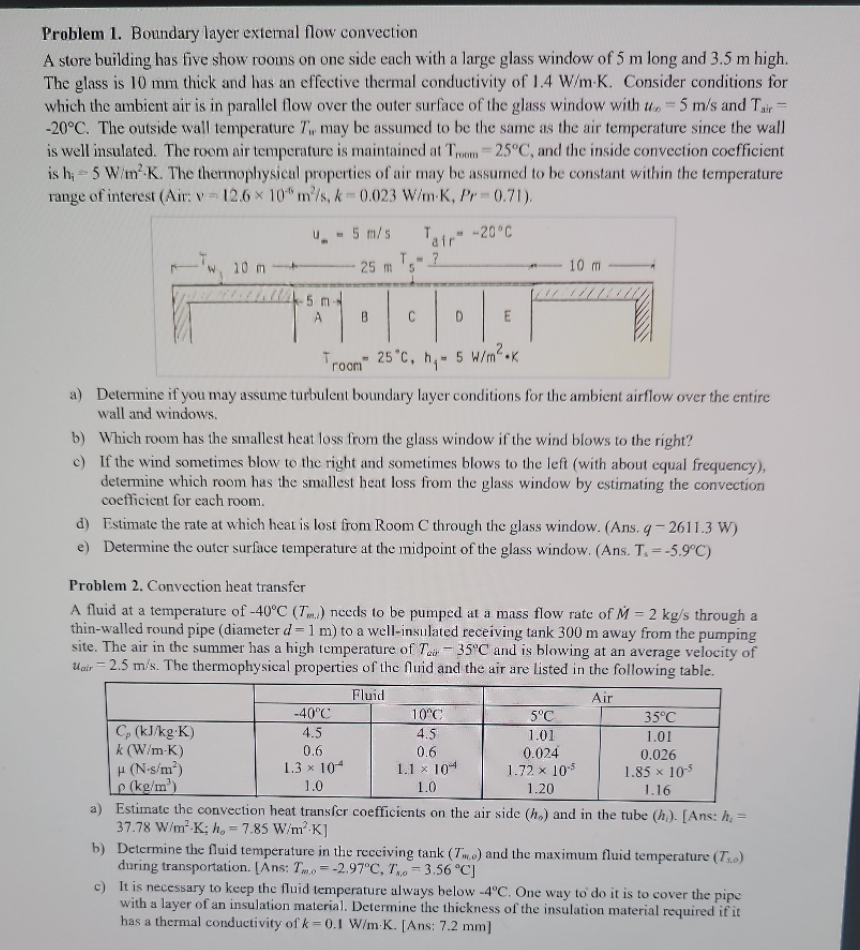
Problem 1. Boundary layer external flow convection = A store building has five show rooms on one side each with a large glass window of 5 m long and 3.5 m high. The glass is 10 mm thick and has an effective thermal conductivity of 1.4 W/m-K. Consider conditions for which the ambient air is in parallel flow over the outer surface of the glass window with u. 5 m/s and Tair -20C. The outside wall temperature T, may be assumed to be the same as the air temperature since the wall is well insulated. The room air temperature is maintained at Troom -25C, and the inside convection coefficient is h; - 5 W/m-K. The thermophysical properties of air may be assumed to be constant within the temperature range of interest (Air: v 12.6 x 10 m/s, k=0.023 W/mK, Pr=0.71). 10 m - 5 m/s 25 m Tair" -20C 10 m T-7 D E m 25C, h- 5 W/mK Troom" a) Determine if you may assume turbulent boundary layer conditions for the ambient airflow over the entire wall and windows. b) Which room has the smallest heat loss from the glass window if the wind blows to the right? c) If the wind sometimes blow to the right and sometimes blows to the left (with about equal frequency), determine which room has the smallest heat loss from the glass window by estimating the convection coefficient for each room. d) Estimate the rate at which heat is lost from Room C through the glass window. (Ans. q-2611.3 W) e) Determine the outer surface temperature at the midpoint of the glass window. (Ans. T, = -5.9C) Problem 2. Convection heat transfer A fluid at a temperature of -40C (Tm) needs to be pumped at a mass flow rate of M = 2 kg/s through a thin-walled round pipe (diameter d=1 m) to a well-insulated receiving tank 300 m away from the pumping site. The air in the summer has a high temperature of Tea -35C and is blowing at an average velocity of Uair 2.5 m/s. The thermophysical properties of the fluid and the air are listed in the following table. Cp (kJ/kg-K) k (W/m-K) (N-s/m) (kg/m) Fluid Air -40C 4.5 10C 4.5 0.6 0.6 1.3 x 10 1.1 x 10⁴ 1.0 1.0 5C 1.01 0.024 1.72 x 10⁻⁵ 1.20 35C 1.01 0.026 1.85 x 10⁻⁵ 1.16 a) Estimate the convection heat transfer coefficients on the air side (h) and in the tube (h). [Ans: h = 37.78 W/m-K; h. = 7.85 W/mK] b) Determine the fluid temperature in the receiving tank (7) and the maximum fluid temperature (To) during transportation. [Ans: Two -2.97C, To 3.56 C] c) It is necessary to keep the fluid temperature always below -4C. One way to do it is to cover the pipe with a layer of an insulation material. Determine the thickness of the insulation material required if it has a thermal conductivity of k = 0.1 W/m-K. [Ans: 7.2 mm]
Step by Step Solution
There are 3 Steps involved in it

Get step-by-step solutions from verified subject matter experts
 Study Help