







Question: Problem 1: Building the AEF Function [30 Points] Suppose that we are in an economy with international trade, the government, domestic consumption, and investment. The
![Problem 1: Building the AEF Function [30 Points] Suppose that we](https://s3.amazonaws.com/si.experts.images/answers/2024/06/66779ffda7a58_77366779ffd8975d.jpg)
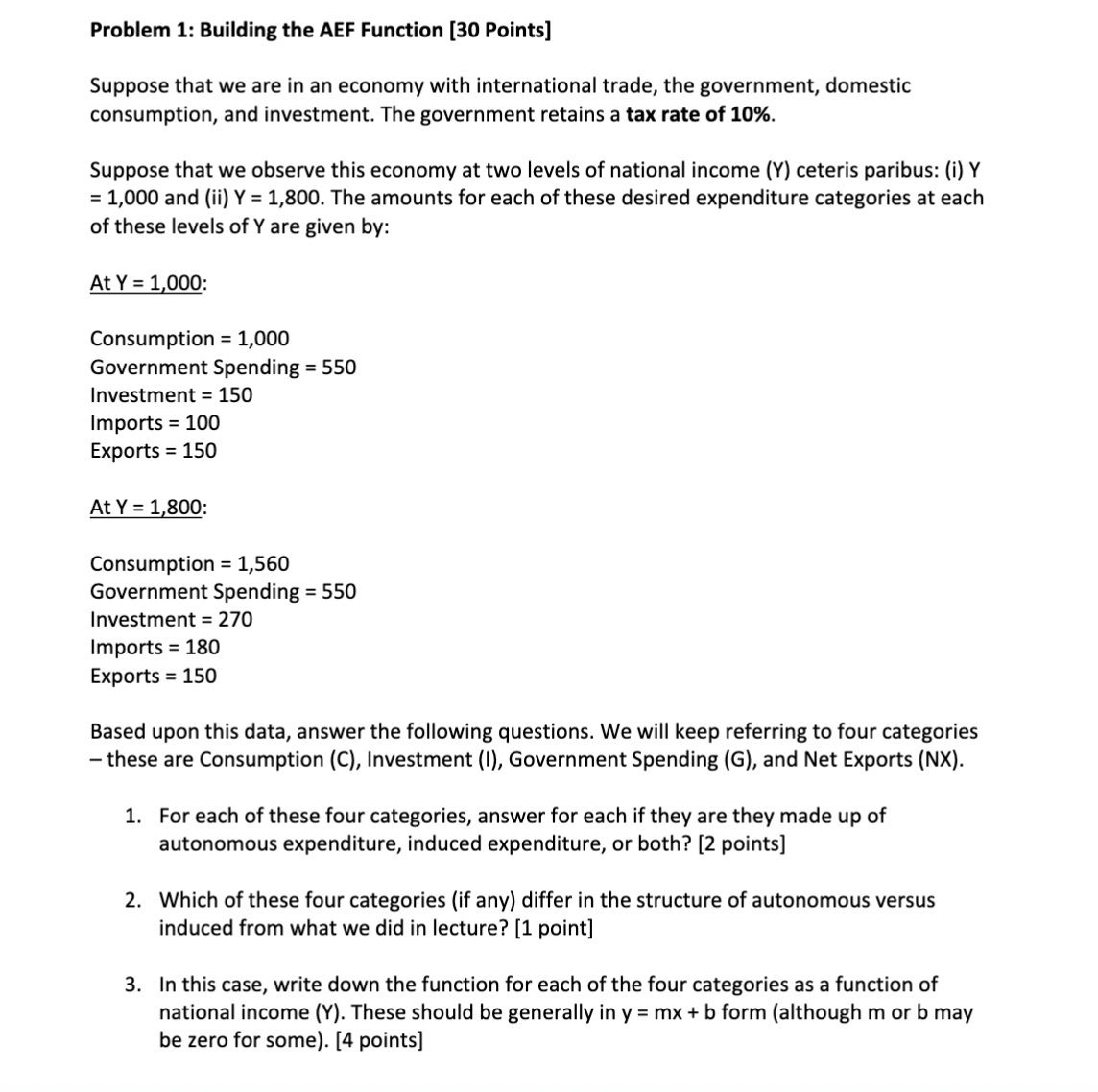
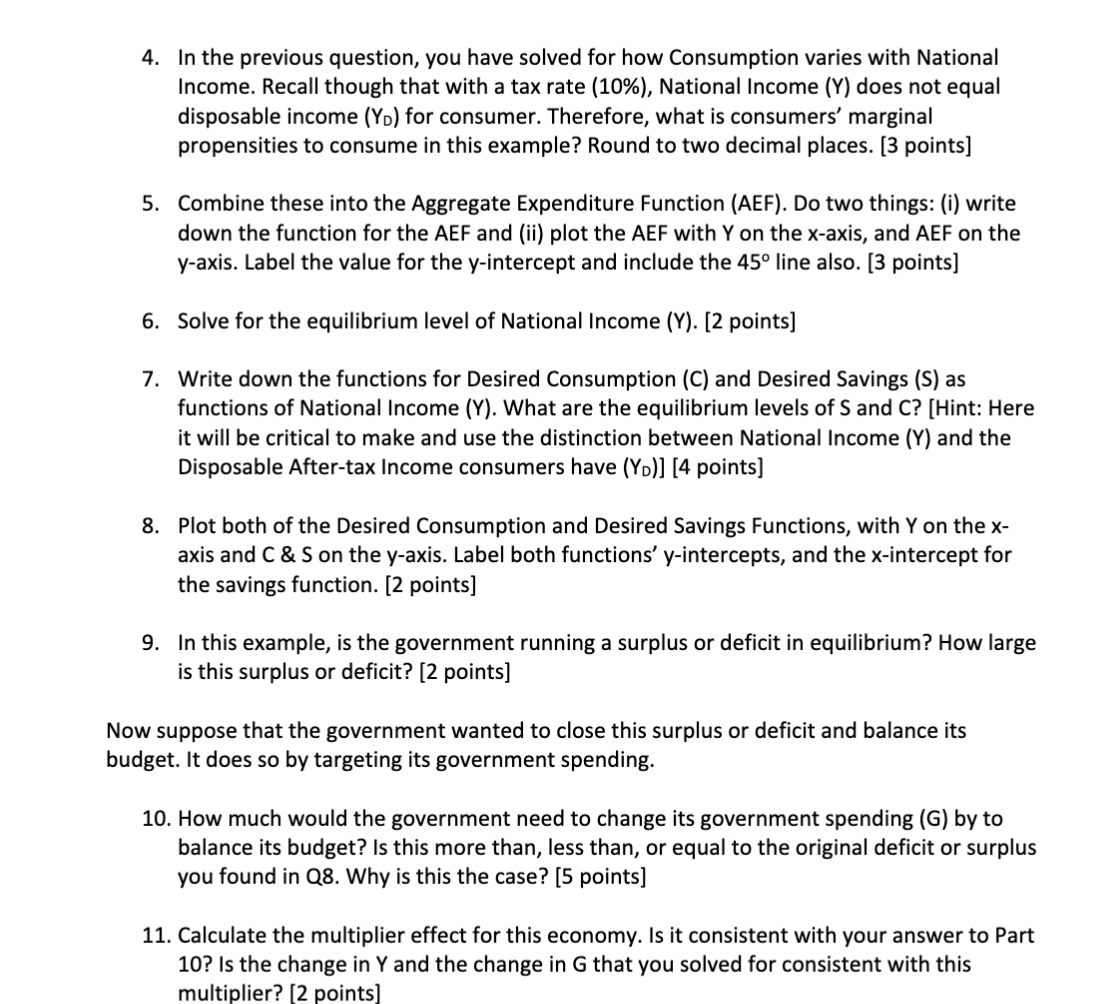
Problem 1: Building the AEF Function [30 Points] Suppose that we are in an economy with international trade, the government, domestic consumption, and investment. The government retains a tax rate of10%. Suppose that we observe this economy at two levels of national income (Y) ceteris paribus: (i) Y = 1,000 and (ii) Y = 1,800. The amounts for each of these desired expenditure categories at each of these levels of Y are given by: At Y = 1.000: Consumption = 1,000 Government Spending = 550 Investment = 150 Imports = 100 Exports = 150 At Y = 1,800: Consumption = 1,560 Government Spending = 550 Investment = 270 Imports = 180 Exports = 150 Based upon this data, answer the following questions. We will keep referring to four categories - these are Consumption (C), Investment (I), Government Spending (G), and Net Exports (NX). 1. For each of these four categories, answer for each if they are they made up of autonomous expenditure, induced expenditure, or both? [2 points] 2. Which of these four categories (if any) differ in the structure of autonomous versus induced from what we did in lecture? [1 point] 3. In this case, write down the function for each of the four categories as a function of national income (Y). These should be generally in y = mx + b form (although m or b may be zero for some). [4 points] 9. In the previous question, you have solved for how Consumption varies with National Income. Recall though that with a tax rate {10%). National Income (Y) does not equal disposable income (YD) for consumer. Therefore, what is consumers' marginal propensities to consume in this example? Round to two decimal places. [3 points] Combine these into the Aggregate Expenditure Function (AEF). Do two things: (i) write down the function for the AEF and (ii) plot the AEF with Y on the xaxis, and AEF on the y-axis. Label the value for the y-intercept and include the 45 line also. [3 points] Solve for the equilibrium level of National Income (Y). [2 points] Write down the functions for Desired Consumption (C) and Desired Savings (5) as functions of National Income (Y). What are the equilibrium levels of S and C? [Hint Here it will be critical to make and use the distinction between National Income (Y) and the Disposable After-tax Income consumers have (You [4 points] Plot both of the Desired Consumption and Desired Savings Functions, with Y on the x- axis and C 8n S on the yaxis. Label both functions' y-intercepts, and the xintercept for the savings function. [2 points] In this example, is the government running a surplus or decit in equilibrium? How large is this surplus or decit? [2 points] Now suppose that the government wanted to close this surplus or decit and balance its budget. It does so by targeting its government spending. 10. How much would the government need to change its government spending (G) by to balance its budget? Is this more than, less than, or equal to the original decit or surplus you found in (18. Why is this the case? [5 points] 11. Calculate the multiplier effect for this economy. Is it consistent with your answer to Part 10? Is the change in Y and the change in G that you solved for consistent with this multiplier? [2 points]
Step by Step Solution
There are 3 Steps involved in it

Get step-by-step solutions from verified subject matter experts
 Study Help