







Question: Problem 1 : Calibration ( 2 5 ' ) Calibration is often required for an instrument before you use it to perform measurements of interest
Problem : Calibration
Calibration is often required for an instrument before you use it to perform measurements of
interest this is to ensure the accuracy of the measurements. Dynamic Mechanical Analyzer
DMA is one of the most commonly used instruments to analyze a material's mechanical
properties. But before you perform any testing on a material, you need to do a calibration first.
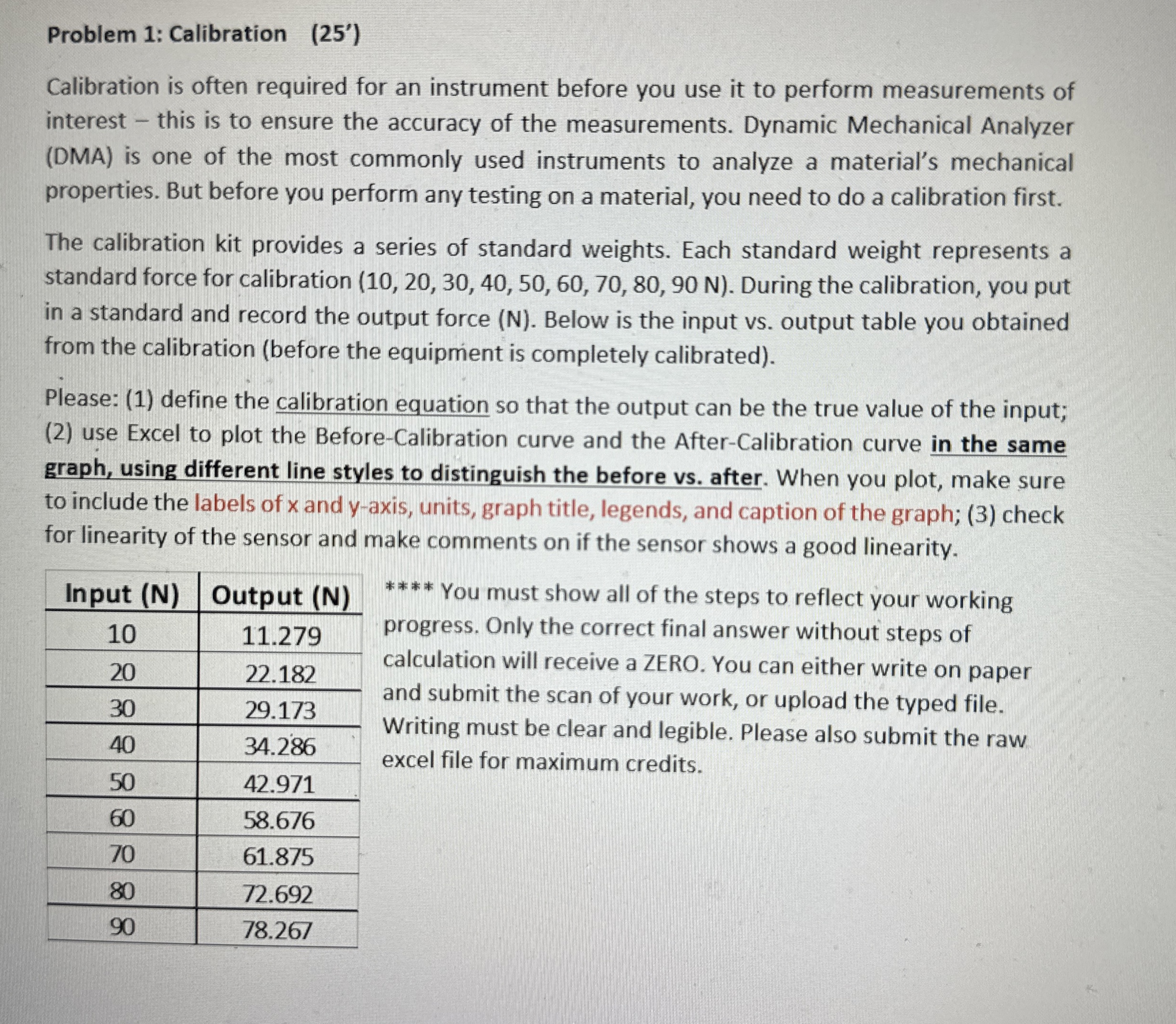
The calibration kit provides a series of standard weights. Each standard weight represents a
standard force for calibration During the calibration, you put
in a standard and record the output force N Below is the input vs output table you obtained
from the calibration before the equipment is completely calibrated
Please: define the calibration equation so that the output can be the true value of the input;
use Excel to plot the BeforeCalibration curve and the AfterCalibration curve in the same
graph, using different line styles to distinguish the before vs after. When you plot, make sure
to include the labels of and axis, units, graph title, legends, and caption of the graph; check
for linearity of the sensor and make comments on if the sensor shows a good linearity.
You must show all of the steps to reflect your working
progress. Only the correct final answer without steps of
calculation will receive a ZERO. You can either write on paper
and submit the scan of your work, or upload the typed file.
Writing must be clear and legible. Please also submit the raw
excel file for maximum credits.
Step by Step Solution
There are 3 Steps involved in it
1 Expert Approved Answer
Step: 1 Unlock

Question Has Been Solved by an Expert!
Get step-by-step solutions from verified subject matter experts
Step: 2 Unlock
Step: 3 Unlock
 Study Help