







Question: Problem 1. Compounds A and B mix uniformly over their entire composition range, both in a solid phase and in a liquid phase. - The
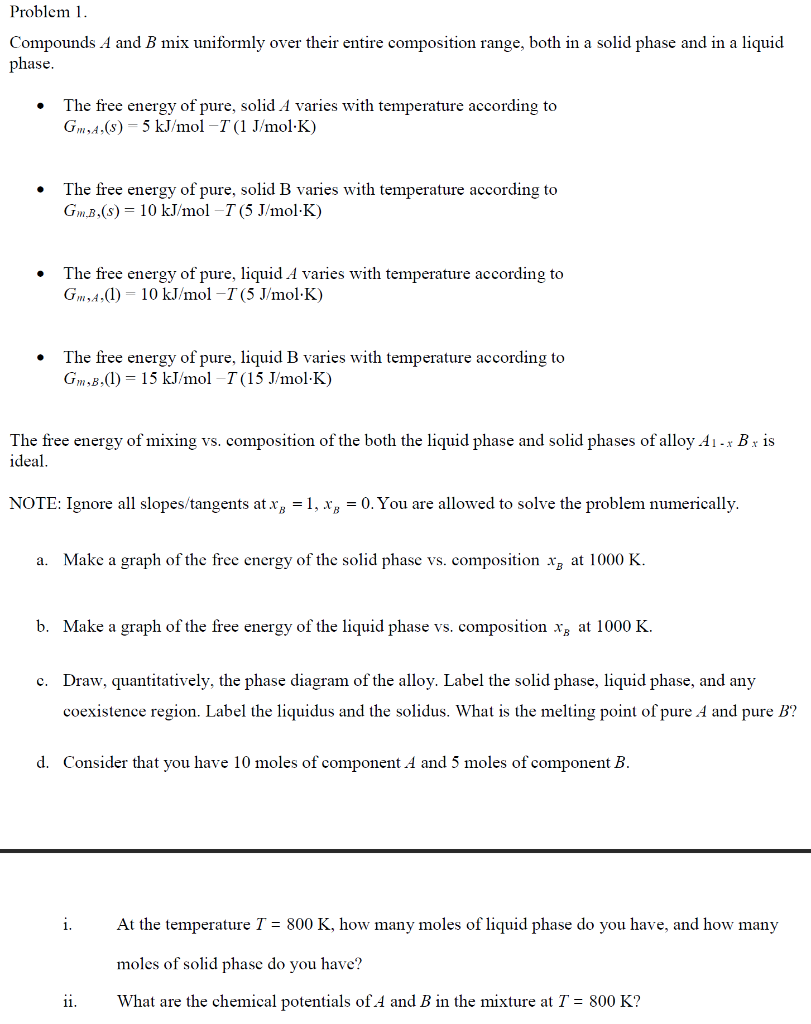
Problem 1. Compounds A and B mix uniformly over their entire composition range, both in a solid phase and in a liquid phase. - The free energy of pure, solid A varies with temperature according to Gm,A,(s)=5kJ/molT(1J/molK) - The free energy of pure, solid B varies with temperature according to Gm,B,(s)=10kJ/molT(5J/molK) - The free energy of pure, liquid A varies with temperature according to Gm,A,(1)=10kJ/molT(5J/molK) - The free energy of pure, liquid B varies with temperature according to Gm,B,(1)=15kJ/molT(15J/molK) The free energy of mixing vs. composition of the both the liquid phase and solid phases of alloy A1xBx is ideal. NOTE: Ignore all slopes/tangents at xB=1,xB=0. You are allowed to solve the problem numerically. a. Make a graph of the free energy of the solid phase vs. composition xB at 1000K. b. Make a graph of the free energy of the liquid phase vs. composition xB at 1000K. c. Draw, quantitatively, the phase diagram of the alloy. Label the solid phase, liquid phase, and any coexistence region. Label the liquidus and the solidus. What is the melting point of pure A and pure B ? d. Consider that you have 10 moles of component A and 5 moles of component B. i. At the temperature T=800K, how many moles of liquid phase do you have, and how many moles of solid phase do you have? ii. What are the chemical potentials of A and B in the mixture at T=800K ? Problem 1. Compounds A and B mix uniformly over their entire composition range, both in a solid phase and in a liquid phase. - The free energy of pure, solid A varies with temperature according to Gm,A,(s)=5kJ/molT(1J/molK) - The free energy of pure, solid B varies with temperature according to Gm,B,(s)=10kJ/molT(5J/molK) - The free energy of pure, liquid A varies with temperature according to Gm,A,(1)=10kJ/molT(5J/molK) - The free energy of pure, liquid B varies with temperature according to Gm,B,(1)=15kJ/molT(15J/molK) The free energy of mixing vs. composition of the both the liquid phase and solid phases of alloy A1xBx is ideal. NOTE: Ignore all slopes/tangents at xB=1,xB=0. You are allowed to solve the problem numerically. a. Make a graph of the free energy of the solid phase vs. composition xB at 1000K. b. Make a graph of the free energy of the liquid phase vs. composition xB at 1000K. c. Draw, quantitatively, the phase diagram of the alloy. Label the solid phase, liquid phase, and any coexistence region. Label the liquidus and the solidus. What is the melting point of pure A and pure B ? d. Consider that you have 10 moles of component A and 5 moles of component B. i. At the temperature T=800K, how many moles of liquid phase do you have, and how many moles of solid phase do you have? ii. What are the chemical potentials of A and B in the mixture at T=800K
Step by Step Solution
There are 3 Steps involved in it

Get step-by-step solutions from verified subject matter experts
 Study Help