Question: Problem 1. Consider a population consisting of five values: 1, 2, 2, 4, and 8. Find the population mean ur and variance o'. Calculate the
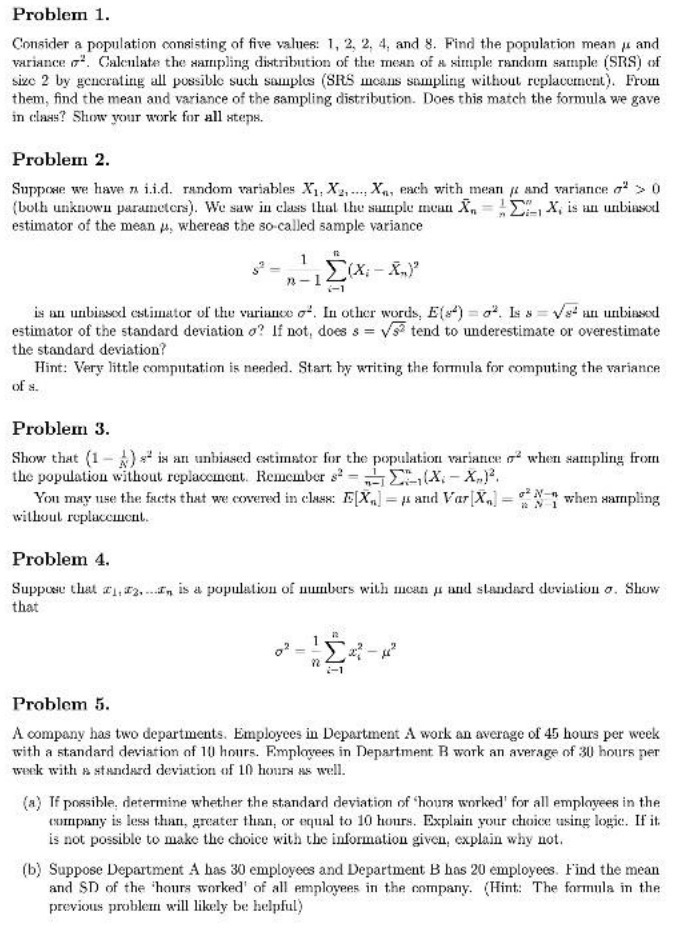
Problem 1. Consider a population consisting of five values: 1, 2, 2, 4, and 8. Find the population mean ur and variance o'. Calculate the sampling distribution of the mean of a simple random sample (SRS) of size 2 by generating all possible such samples (SRS means sampling without replacement). From them, find the mean and variance of the sampling distribution. Does this match the formula we gave in class? Show your work for all steps. Problem 2. Suppose we have a i.id. random variables X], X2, ...; Xn, each with mean { and variance a' > 0 (both unknown parameters). We saw in class that the sample mean X, = 1 2, X, is an unbiased estimator of the mean a, whereas the so-called sample variance (X - XY is an unbiased estimator of the variance o'. In other words, E(s) = o'. Is s = va- an unbiased estimator of the standard deviation o? If not, does s = vs tend to underestimate or overestimate the standard deviation? Hint: Very little computation is needed. Start by writing the formula for computing the variance of a. Problem 3. Show that (1 -) , is an unbiased estimator for the population variance of when sampling from the population without replacement. Remember s' = , Et,(X - X.). You may use the facts that we covered in class: E[X,] = / and Var [X.] = $ 7 N"when sampling without replacement. Problem 4. Suppose that 21,22. ...I, is a population of numbers with moan a and standard deviation o. Show that Problem 5. A company has two departments. Employees in Department A work an average of 45 hours per week with a standard deviation of 10 hours. Employees in Department B work an average of 30 hours per week with a standard deviation of 10 hours as well. (a) If possible, determine whether the standard deviation of 'hours worked' for all employees in the company is less than, greater than, or equal to 10 hours. Explain your choice using logic. If it. is not possible to make the choice with the information given, explain why not. (b) Suppose Department A has 30 employees and Department B has 20 employees. Find the mean and SD of the hours worked' of all employees in the company. (Hint: The formula in the previous problem will likely be helpful)









 Study Help