







Question: Problem 1 Consider the RBC model in the slides. Assume that labor supply is variable: Agents choose optimally how much labor to supply in
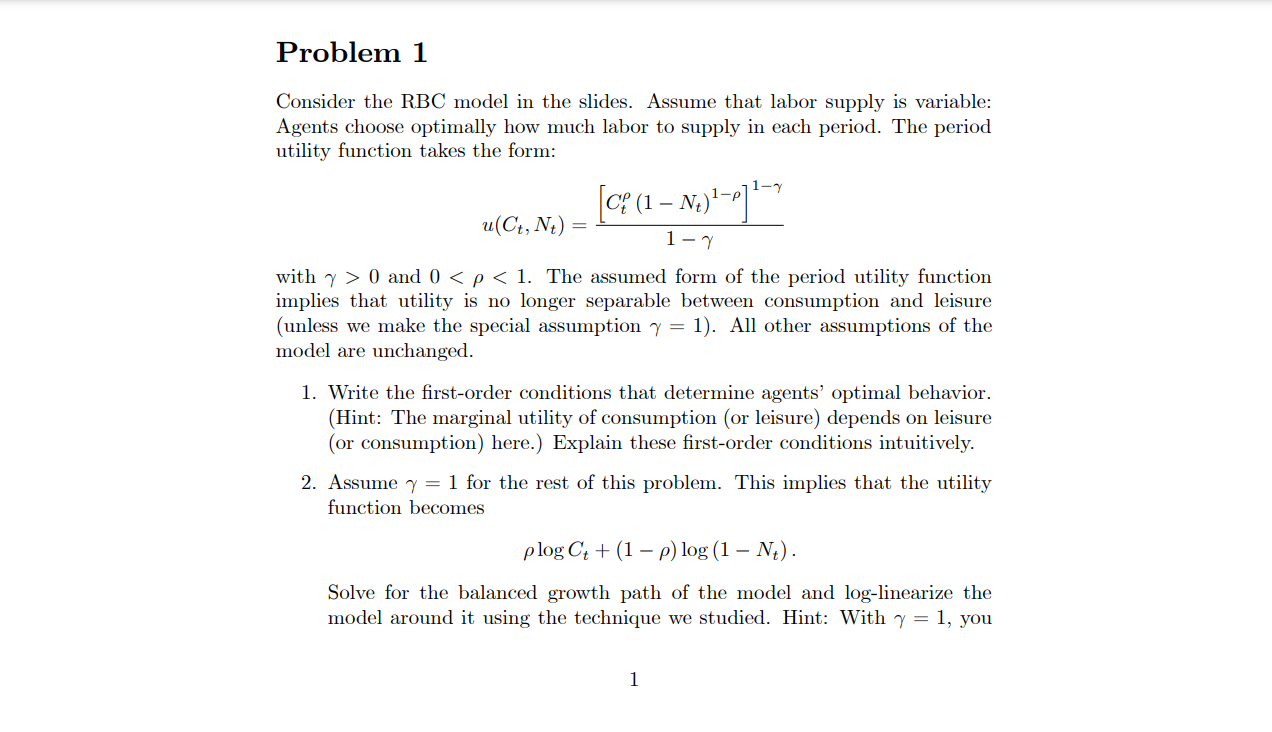
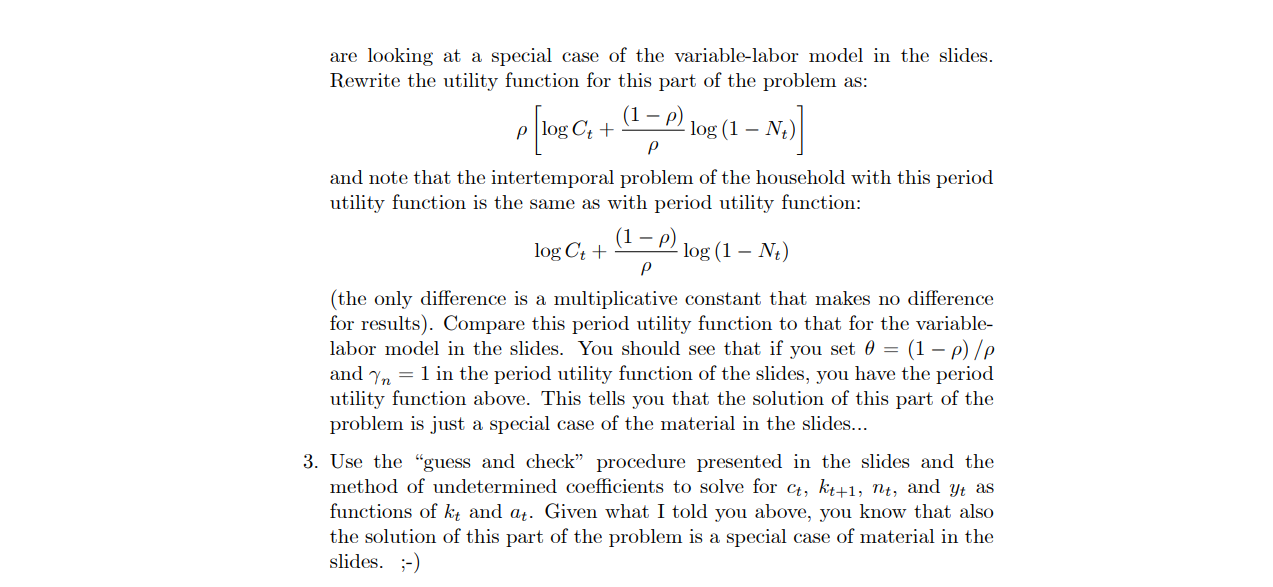
Problem 1 Consider the RBC model in the slides. Assume that labor supply is variable: Agents choose optimally how much labor to supply in each period. The period utility function takes the form: - u(Ct, Nt): 1-7 with > 0 and 0 < p < 1. The assumed form of the period utility function implies that utility is no longer separable between consumption and leisure (unless we make the special assumption = 1). All other assumptions of the model are unchanged. 1. Write the first-order conditions that determine agents' optimal behavior. (Hint: The marginal utility of consumption (or leisure) depends on leisure (or consumption) here.) Explain these first-order conditions intuitively. 2. Assume 71 for the rest of this problem. This implies that the utility function becomes plog C++ (1p) log (1 - Nt). Solve for the balanced growth path of the model and log-linearize the model around it using the technique we studied. Hint: With y = 1, you 1 are looking at a special case of the variable-labor model in the slides. Rewrite the utility function for this part of the problem as: plog C++ (1-p) P [ log (1-N) and note that the intertemporal problem of the household with this period utility function is the same as with period utility function: log C+ (1 - p) log (1 - N) P (the only difference is a multiplicative constant that makes no difference for results). Compare this period utility function to that for the variable- labor model in the slides. You should see that if you set 0 = (1 - p)/p and 1 in the period utility function of the slides, you have the period utility function above. This tells you that the solution of this part of the problem is just a special case of the material in the slides.... 3. Use the "guess and check" procedure presented in the slides and the method of undetermined coefficients to solve for ct, kt+1, nt, and yt as functions of k and a. Given what I told you above, you know that also the solution of this part of the problem is a special case of material in the slides. ;-)
Step by Step Solution
There are 3 Steps involved in it

Get step-by-step solutions from verified subject matter experts
 Study Help