







Question: Problem 1. Consider the relational schema R = ABC. Assume that F = {AC, ACB, BAC}. a) Find the cover of F: (i.e., the
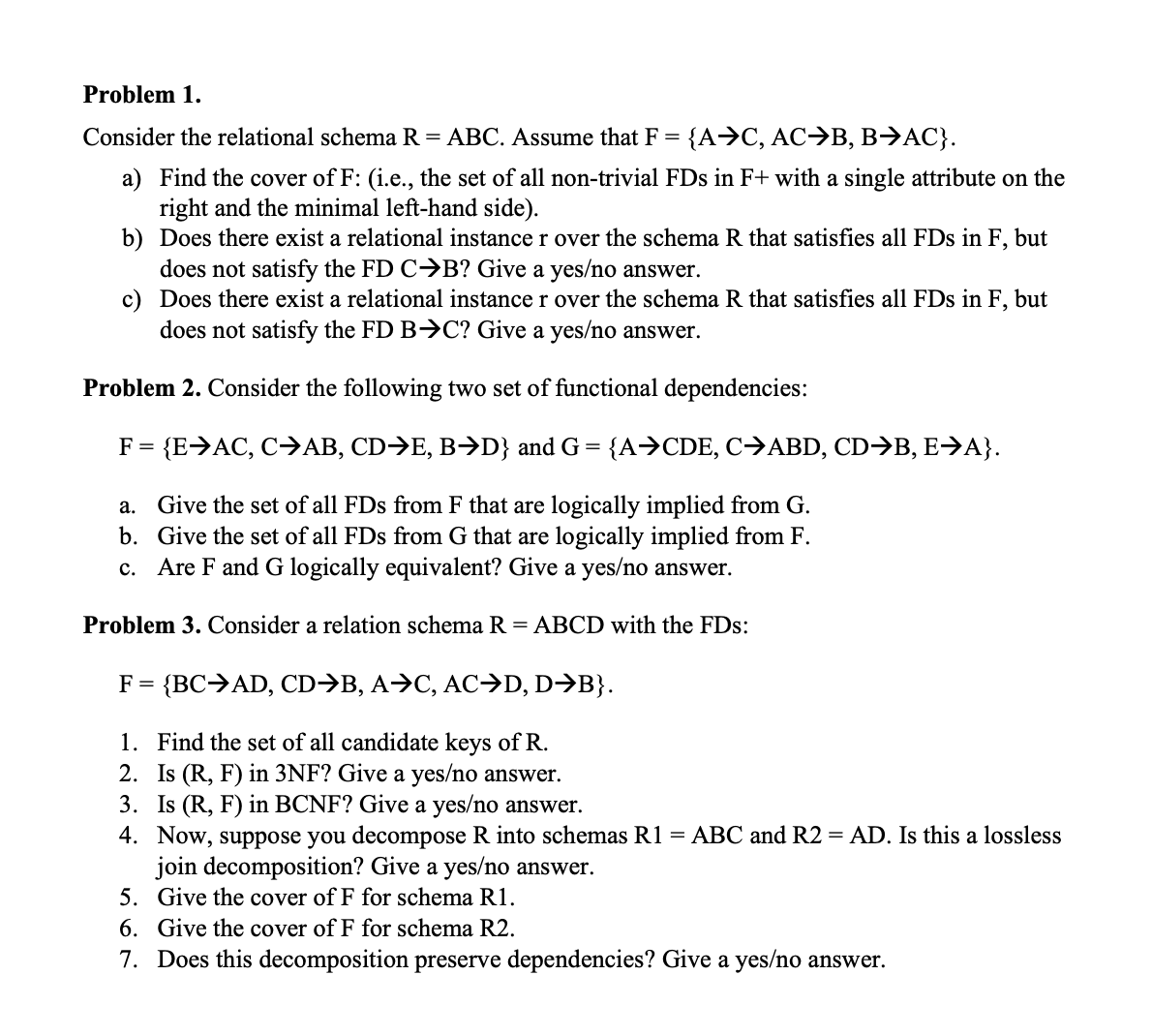
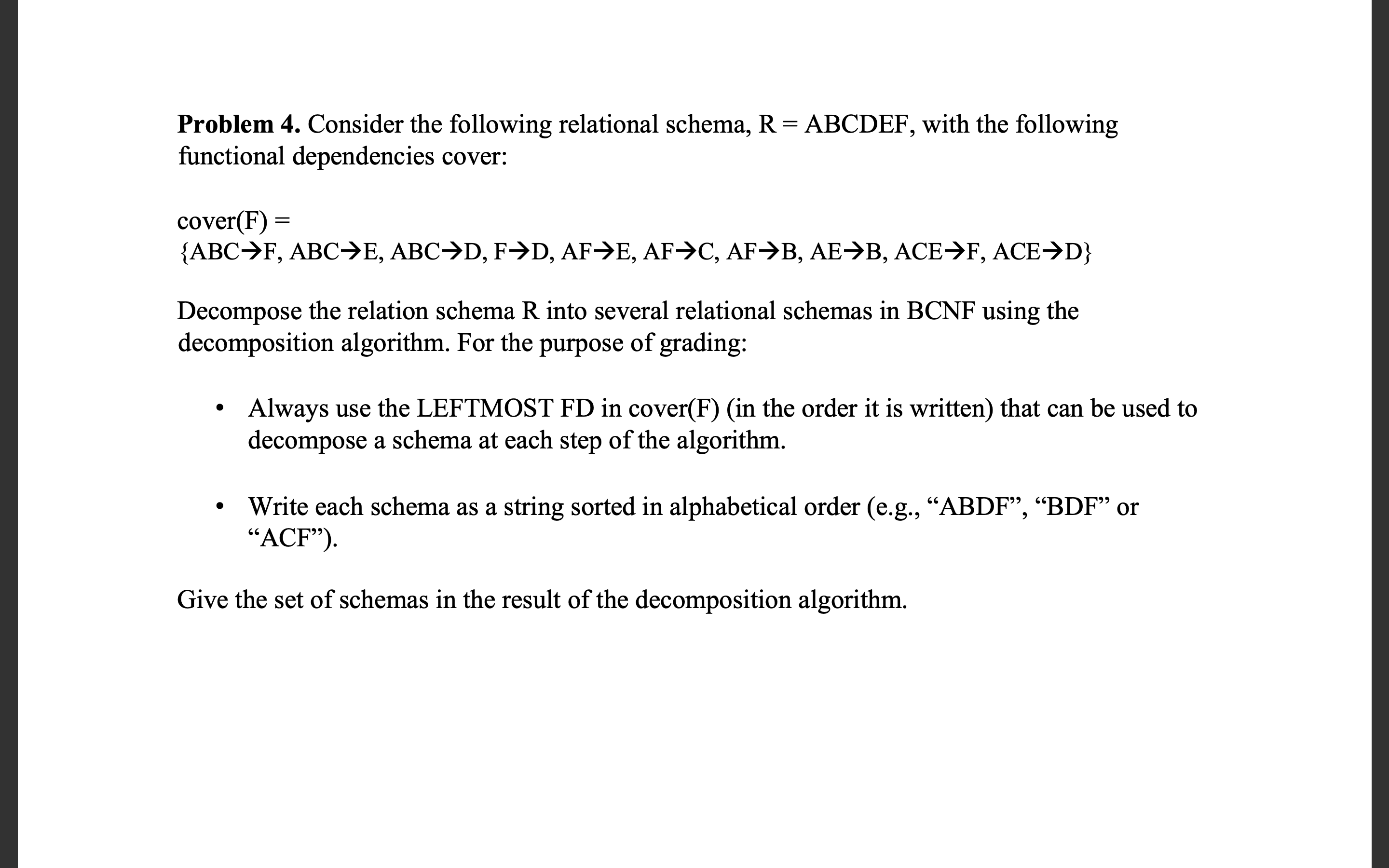
Problem 1. Consider the relational schema R = ABC. Assume that F = {AC, ACB, BAC}. a) Find the cover of F: (i.e., the set of all non-trivial FDs in F+ with a single attribute on the right and the minimal left-hand side). b) Does there exist a relational instance r over the schema R that satisfies all FDs in F, but does not satisfy the FD CB? Give a yes/no answer. c) Does there exist a relational instance r over the schema R that satisfies all FDs in F, but does not satisfy the FD BC? Give a yes/no answer. Problem 2. Consider the following two set of functional dependencies: F = = {EAC, CAB, CDE, BD} and G = {ACDE, CABD, CDB, EA}. a. Give the set of all FDs from F that are logically implied from G. b. Give the set of all FDs from G that are logically implied from F. C. Are F and G logically equivalent? Give a yes/no answer. Problem 3. Consider a relation schema R = ABCD with the FDs: F = {BCAD, CDB, AC, ACD, DB}. 1. Find the set of all candidate keys of R. 2. Is (R, F) in 3NF? Give a yes/no answer. 3. Is (R, F) in BCNF? Give a yes/no answer. 4. Now, suppose you decompose R into schemas R1 = ABC and R2 = AD. Is this a lossless join decomposition? Give a yes/no answer. 5. Give the cover of F for schema R1. 6. Give the cover of F for schema R2. 7. Does this decomposition preserve dependencies? Give a yes/no answer. Problem 4. Consider the following relational schema, R = ABCDEF, with the following functional dependencies cover: cover(F) = {ABCF, ABCE, ABCD, FD, AFE, AFC, AFB, AEB, ACEF, ACED} Decompose the relation schema R into several relational schemas in BCNF using the decomposition algorithm. For the purpose of grading: Always use the LEFTMOST FD in cover(F) (in the order it is written) that can be used to decompose a schema at each step of the algorithm. Write each schema as a string sorted in alphabetical order (e.g., "ABDF", "BDF" or "ACF"). Give the set of schemas in the result of the decomposition algorithm.
Step by Step Solution
There are 3 Steps involved in it

Get step-by-step solutions from verified subject matter experts
 Study Help