







Question: Problem 1 Considering functions f(n) 2 0, g(n) 2 0, and constant c > 0, indicate whether each of the following statements is true. Prove
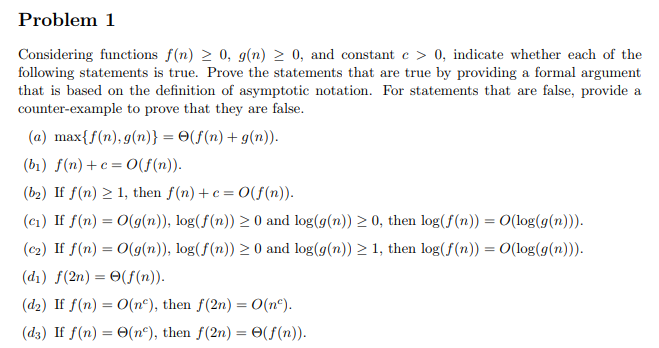
Problem 1 Considering functions f(n) 2 0, g(n) 2 0, and constant c > 0, indicate whether each of the following statements is true. Prove the statements that are true by providing a formal argument that is based on the definition of asymptotic notation. For statements that are false, provide a counter-example to prove that they are false (a) max[f(n).g(n))- e(f(n)+g(n) (bi) f(n)+c-O(f(n). (b2) If f(n) 21, then f(n)-O(f(n)) (a) If f(n) 0(g(n)), log(f(n))2 0 and logg(n))2 0, then log(f(n)) = 0(log(g(n))). (c2) If f(n) - O(g(n), log(f (n)0 and log(g(n)) 1, then log(f(n)) - O(log(g(n))). (di) f(2n)-e((n) (d2) If f(n)-O(n), then f(2n)-O(n). (ds) Iff(n)-(n, then f(2n)-e((n))
Step by Step Solution
There are 3 Steps involved in it

Get step-by-step solutions from verified subject matter experts
 Study Help