







Question: Problem 1 continued Plotted in part d (below) is an indifference curve/budget constraint diagram that displays the point at which consumption-savings optimality arises based on
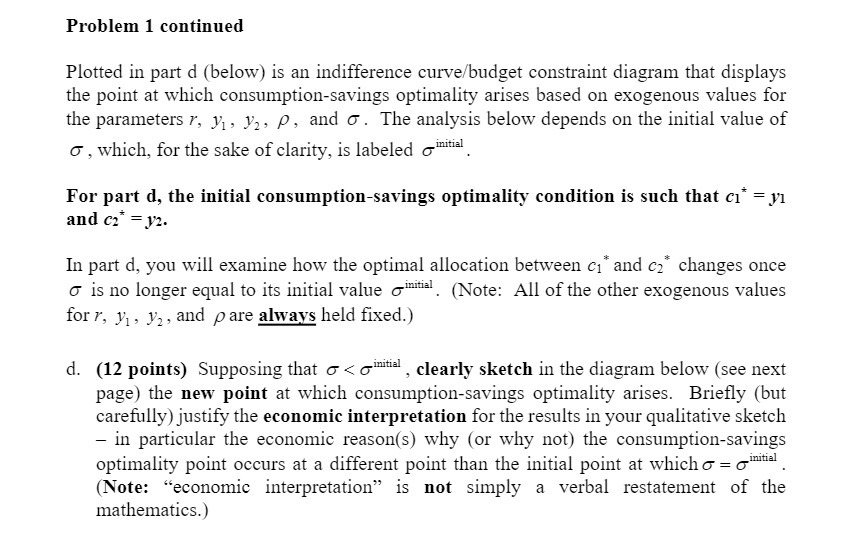
Problem 1 continued Plotted in part d (below) is an indifference curve/budget constraint diagram that displays the point at which consumption-savings optimality arises based on exogenous values for the parameters 7, y] , 12, p, and . The analysis below depends on the initial value of o, which, for the sake of clarity, is labeled initial For part d, the initial consumption-savings optimality condition is such that c1* = yl and c2 = 12. In part d, you will examine how the optimal allocation between c1" and c2" changes once is no longer equal to its initial value . (Note: All of the other exogenous values for r, y1 , 12, and pare always held fixed.) d. (12 points) Supposing that o
Step by Step Solution
There are 3 Steps involved in it

Get step-by-step solutions from verified subject matter experts
 Study Help