







Question: Problem 1. Design a small database for used textbooks, as might be used by an on-line trading site like Amazon. The database will store textbooks
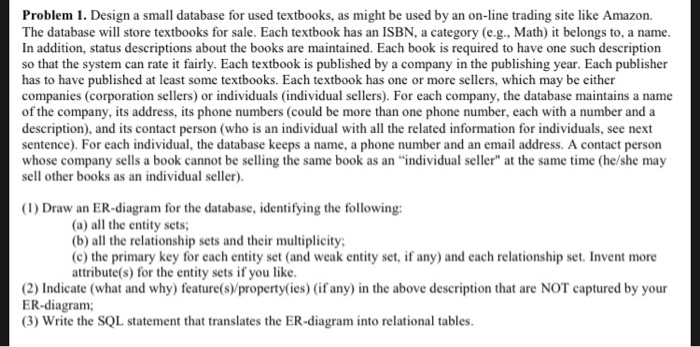
Problem 1. Design a small database for used textbooks, as might be used by an on-line trading site like Amazon. The database will store textbooks for sale. Each textbook has an ISBN, a category (e.g., Math) it belongs to, a name. In addition, status descriptions about the books are maintained. Each book is required to have one such description so that the system can rate it fairly. Each textbook is published by a company in the publishing year. Each publisher has to have published at least some textbooks. Each textbook has one or more sellers, which may be either companies (corporation sellers) or individuals (individual sellers). For each company, the database maintains a name of the company, its address, its phone numbers (could be more than one phone number, each with a number and a description), and its contact person (who is an individual with all the related information for individuals, see next sentence). For each individual, the database keeps a name, a phone number and an email address. A contact person whose company sells a book cannot be selling the same book as an "individual seller" at the same time (he/she may sell other books as an individual seller) (1) Draw an ER-diagram for the database, identifying the following: (a) all the entity sets; (b) all the relationship sets and their multiplicity; (c) the primary key for each entity set (and weak entity set, if any) and each relationship set. Invent more attribute(s) for the entity sets if you like (2) Indicate (what and why) feature(s)property(ies) (if any) in the above description that are NOT captured by your ER-diagram; (3) Write the SQL statement that translates the ER-diagram into relational tables
Step by Step Solution
There are 3 Steps involved in it

Get step-by-step solutions from verified subject matter experts
 Study Help