







Question: Problem 1 . Envy: a capital sin Consider the following ultimatum bargaining game. There is 1 unit of a good and player 1 offers a
Problem Envy: a capital sin
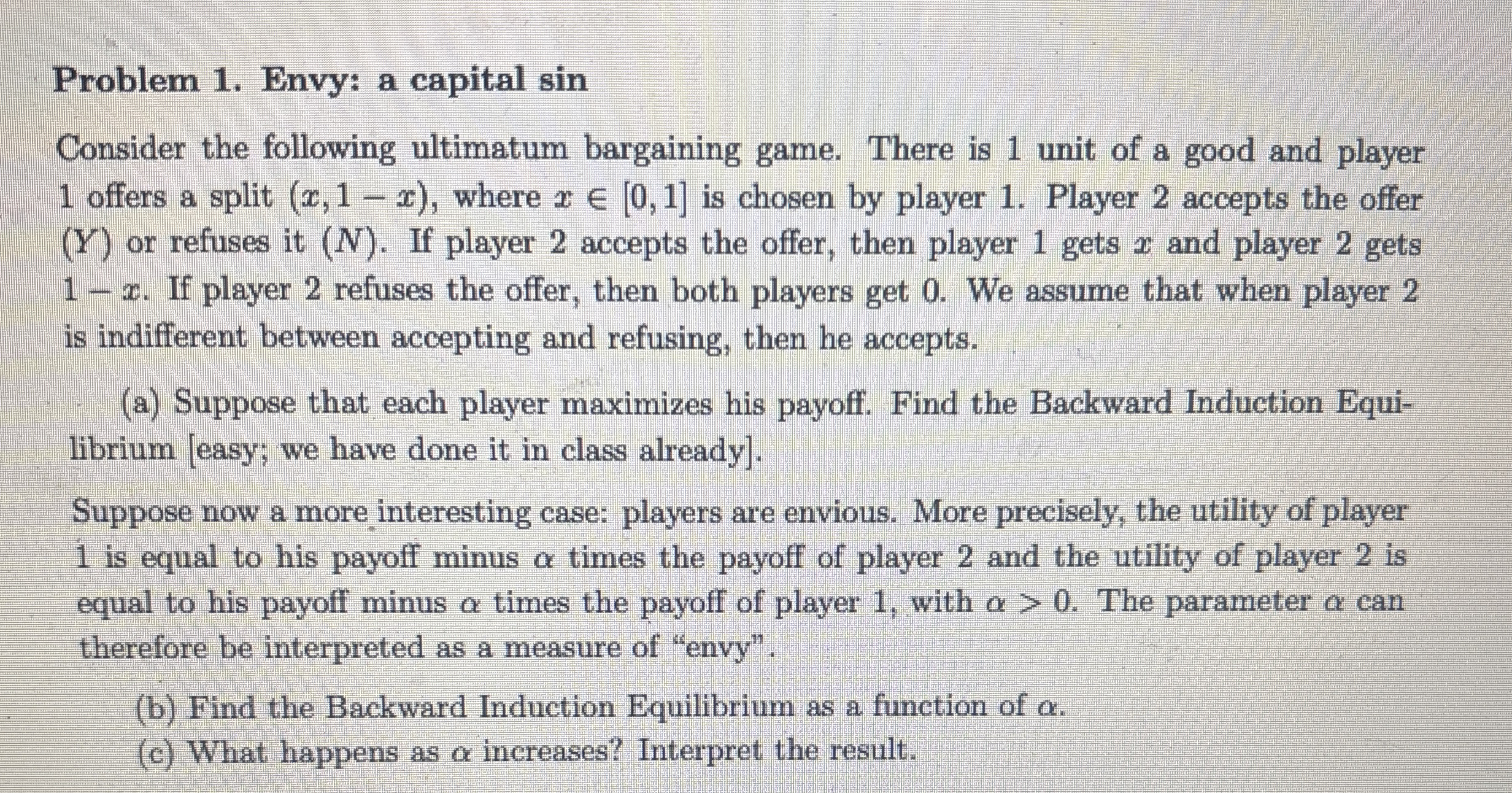
Consider the following ultimatum bargaining game. There is unit of a good and player offers a split where xin is chosen by player Player accepts the offer or refuses it If player accepts the offer, then player gets and player gets If player refuses the offer, then both players get We assume that when player is indifferent between accepting and refusing, then he accepts.
a Suppose that each player maximizes his payoff. Find the Backward Induction Equilibrium easy; we have done it in class already
Suppose now a more interesting case: players are envious. More precisely, the utility of player is equal to his payoff minus times the payoff of player and the utility of player is equal to his payoff minus times the payoff of player with The parameter can therefore be interpreted as a measure of "envy".
b Find the Backward Induction Equilibrium as a function of
c What happens as increases? Interpret the result.
Step by Step Solution
There are 3 Steps involved in it
1 Expert Approved Answer
Step: 1 Unlock

Question Has Been Solved by an Expert!
Get step-by-step solutions from verified subject matter experts
Step: 2 Unlock
Step: 3 Unlock
 Study Help