







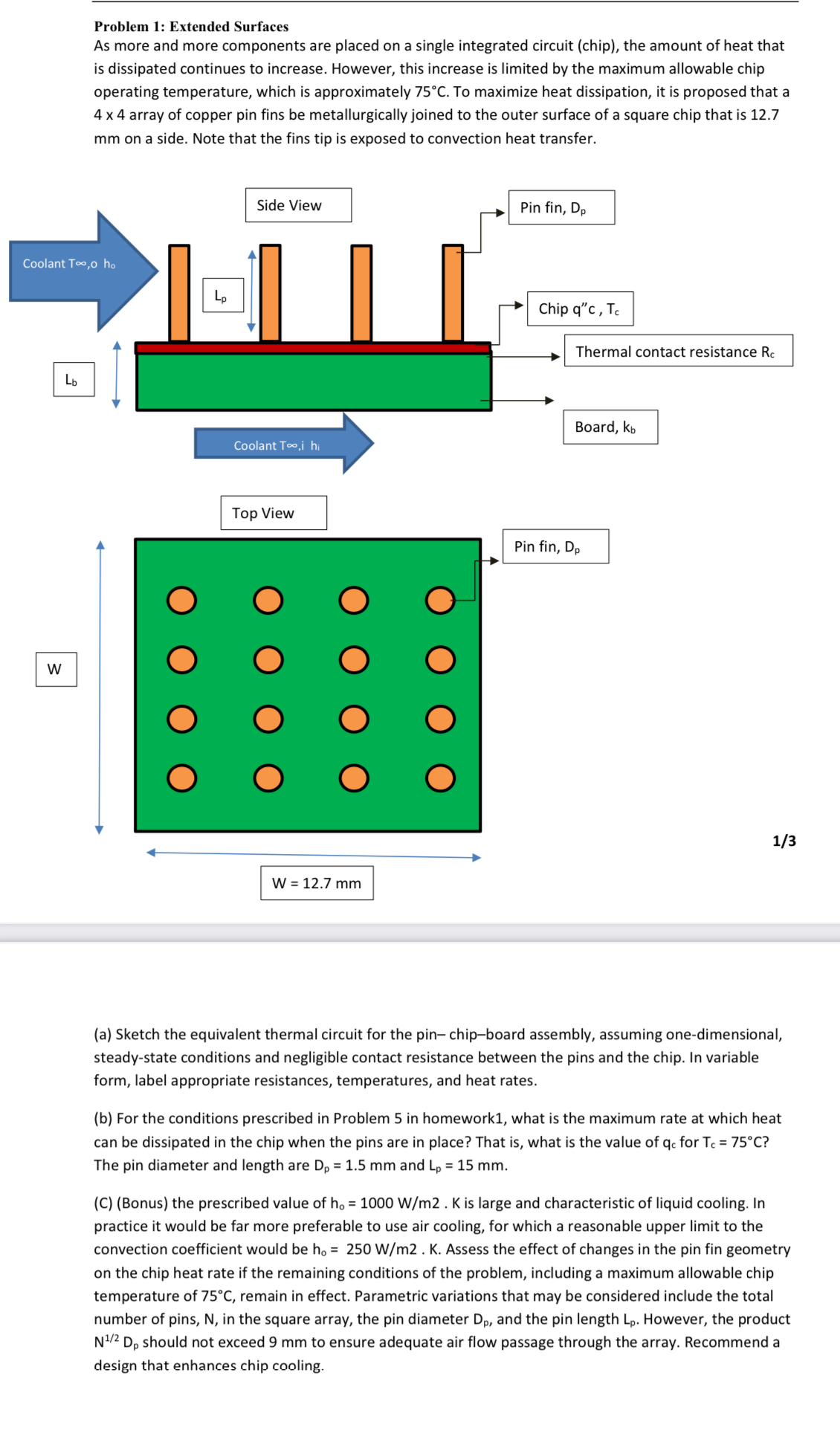
Question: Problem 1 : Extended Surfaces As more and more components are placed on a single integrated circuit ( chip ) , the amount of heat
Problem : Extended Surfaces
As more and more components are placed on a single integrated circuit chip the amount of heat that
is dissipated continues to increase. However, this increase is limited by the maximum allowable chip
operating temperature, which is approximately To maximize heat dissipation, it is proposed that a
array of copper pin fins be metallurgically joined to the outer surface of a square chip that is
mm on a side. Note that the fins tip is exposed to convection heat transfer.
a Sketch the equivalent thermal circuit for the pinchipboard assembly, assuming onedimensional,
steadystate conditions and negligible contact resistance between the pins and the chip. In variable
form, label appropriate resistances, temperatures, and heat rates.
b For the conditions prescribed in Problem in homework what is the maximum rate at which heat
can be dissipated in the chip when the pins are in place? That is what is the value of for
The pin diameter and length are and
CBonus the prescribed value of is large and characteristic of liquid cooling. In
practice it would be far more preferable to use air cooling, for which a reasonable upper limit to the
convection coefficient would be K Assess the effect of changes in the pin fin geometry
on the chip heat rate if the remaining conditions of the problem, including a maximum allowable chip
temperature of remain in effect. Parametric variations that may be considered include the total
number of pins, in the square array, the pin diameter and the pin length However, the product
should not exceed mm to ensure adequate air flow passage through the array. Recommend a
design that enhances chip cooling.
Step by Step Solution
There are 3 Steps involved in it
1 Expert Approved Answer
Step: 1 Unlock

Question Has Been Solved by an Expert!
Get step-by-step solutions from verified subject matter experts
Step: 2 Unlock
Step: 3 Unlock
 Study Help