







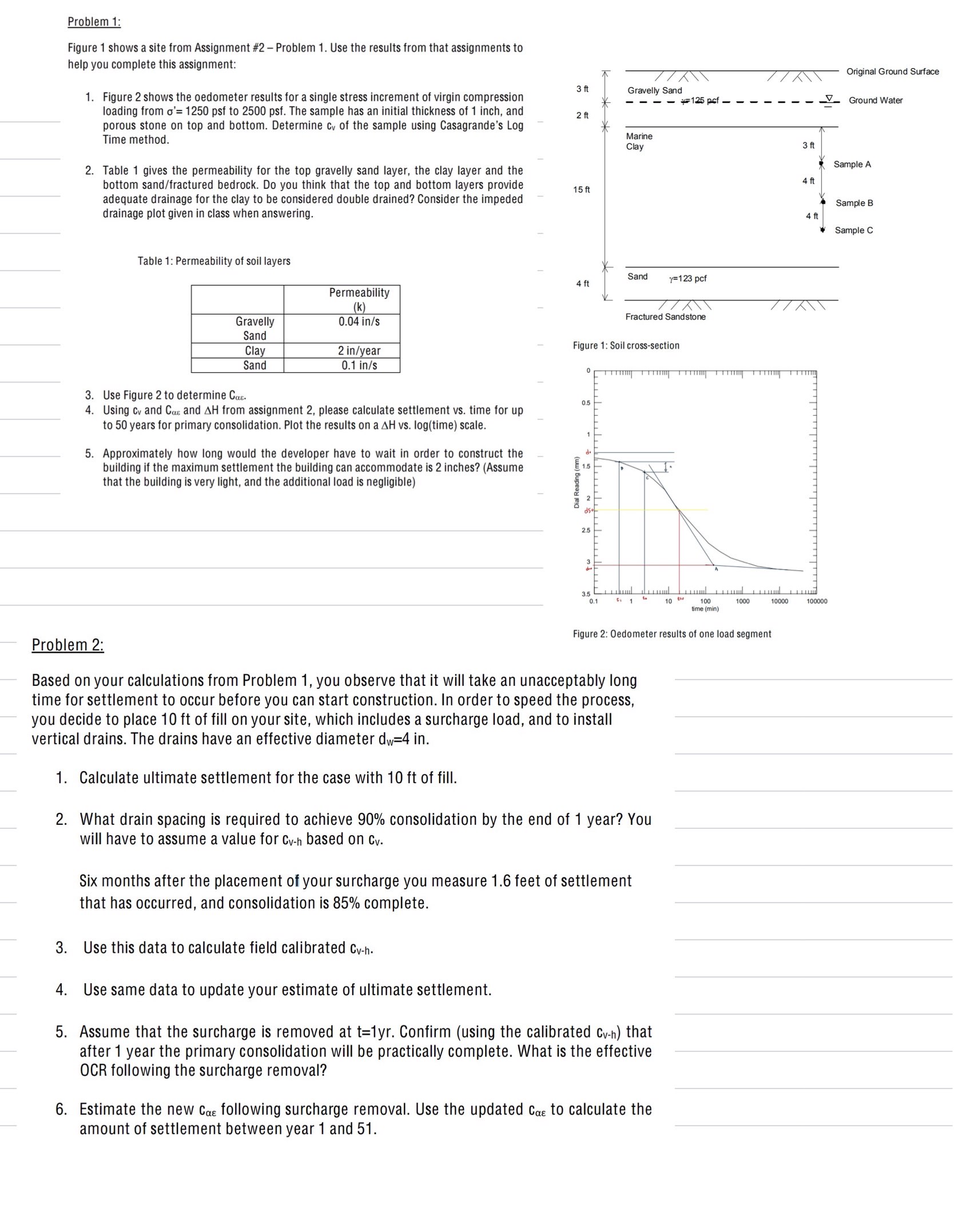
Question: Problem 1 : Figure 1 shows a site from Assignment # 2 - Problem 1 . Use the results from that assignments to help
Problem :
Figure shows a site from Assignment # Problem Use the results from that assignments to help you complete this assignment:
Figure shows the oedometer results for a single stress increment of virgin compression loading from sigmaprime psf to psf The sample has an initial thickness of inch, and porous stone on top and bottom. Determine mathbfcmathrmv of the sample using Casagrande's Log Time method.
Table gives the permeability for the top gravelly sand layer, the clay layer and the bottom sandfractured bedrock. Do you think that the top and bottom layers provide adequate drainage for the clay to be considered double drained? Consider the impeded drainage plot given in class when answering.
Table : Permeability of soil layers
Use Figure to determine mathrmCalpha varepsilon
Using mathrmCv and mathrmCalpha varepsilon and Delta mathrmH from assignment please calculate settlement vs time for up to years for primary consolidation. Plot the results on a Delta H vslog time scale.
Approximately how long would the developer have to wait in order to construct the building if the maximum settlement the building can accommodate is inches? Assume that the building is very light, and the additional load is negligible
Problem :
Figure : Oedometer results of one load segment
Based on your calculations from Problem you observe that it will take an unacceptably long time for settlement to occur before you can start construction. In order to speed the process, you decide to place ft of fill on your site, which includes a surcharge load, and to install vertical drains. The drains have an effective diameter mathrmdmathrmw in
Calculate ultimate settlement for the case with ft of fill.
What drain spacing is required to achieve consolidation by the end of year? You will have to assume a value for cvh based on cv
Six months after the placement of your surcharge you measure feet of settlement that has occurred, and consolidation is complete.
Use this data to calculate field calibrated mathrmcmathrmvmathrmh
Use same data to update your estimate of ultimate settlement.
Assume that the surcharge is removed at t y r Confirm using the calibrated mathrmcmathrmvmathrmh that after year the primary consolidation will be practically complete. What is the effective OCR following the surcharge removal?
Estimate the new mathrmCalpha overline following surcharge removal. Use the updated mathrmCalpha varepsilon to calculate the amount of settlement between year and
Step by Step Solution
There are 3 Steps involved in it
1 Expert Approved Answer
Step: 1 Unlock

Question Has Been Solved by an Expert!
Get step-by-step solutions from verified subject matter experts
Step: 2 Unlock
Step: 3 Unlock
 Study Help