







Question: Problem 1: Game Theory [7 Points] Suppose that two players [A 8: B} play a game. The players each have a bowl filled with 30
![Problem 1: Game Theory [7 Points] Suppose that two players [A](https://s3.amazonaws.com/si.experts.images/answers/2024/06/667dd6c37b613_011667dd6c36605c.jpg)
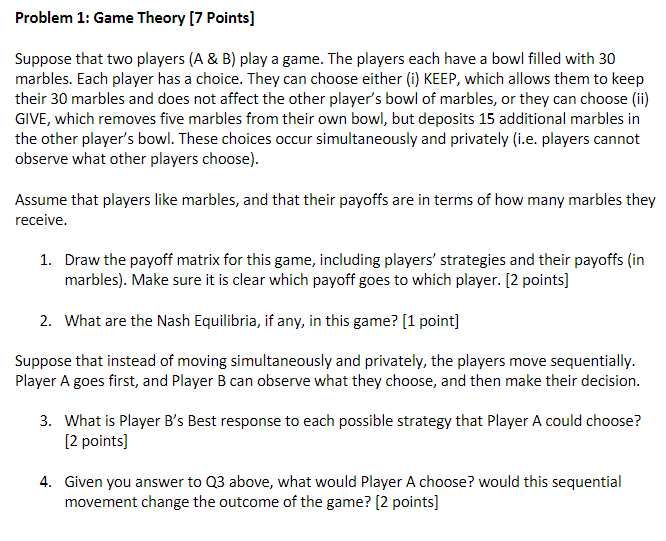
Problem 1: Game Theory [7 Points] Suppose that two players [A 8: B} play a game. The players each have a bowl filled with 30 marbles. Each player has a choice. They can choose either ii] KEEP, which allows them to keep their 30 marbles and does not affect the other player's bowl of marbles, or they can choose iii} GIVE, which removes five marbles from their own bowl, but deposits 15 additional marbles in the other player's bowl. These choices occur simultaneously and privately [i.e. players cannot observe what other players choose}. Assume that players like marblesJ and that their payoffs are in terms of how many marbles they receive. 1. Draw the payoff matrix for this game, including players' strategies and their payoffs {in ma rbles). Make sure it is clear which payoff goes to which player. [2 points] 2. What are the Nash Equilibria, if any; in this game? [1 point] Suppose that instead of moving simultaneously and privately; the players move sequentially. Player A goes first, and Player B can observe what they choose; and then make their decision. 3. What is Player B's Best response to each possible strategy that PlayerA could choose? [2 points] 4. Given you answer to (13 above what would Player A choose? would this sequential movement change the outcome of the game? [2 points]
Step by Step Solution
There are 3 Steps involved in it

Get step-by-step solutions from verified subject matter experts
 Study Help