Question: Problem #1 Hamis Consulting Company (HCC) is planning to develop an app that can produce a diet plan based on the elient's (or user's) preferences.
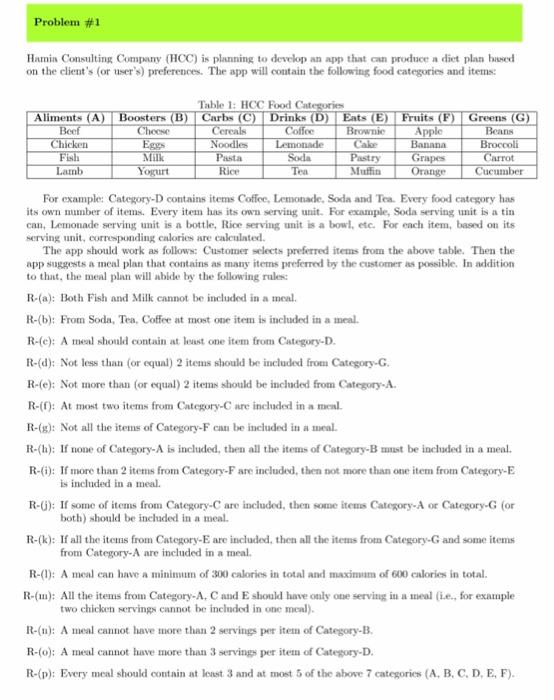
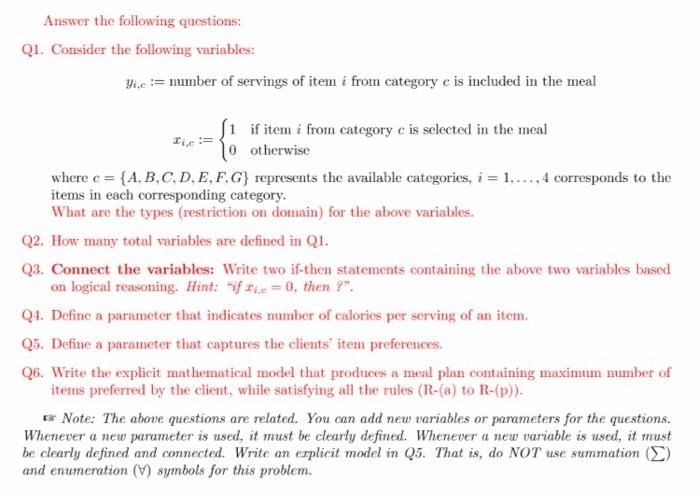
Problem #1 Hamis Consulting Company (HCC) is planning to develop an app that can produce a diet plan based on the elient's (or user's) preferences. The app will contain the following food categories and items: For example: Category-D contains items Coffee, Lenonade, Soda and Tea. Every food eategory has its own number of items. Every item has its own serving unit. For example, Soda serving unit is a tin can, Lemonade serving unit is a bottle, Rice serving unit is a bowl, etc. For each item, based on its serving unit, corresponding calories are calculnted. The app should work as follows: Customer selects preferred items from the above table. Then the app suggests a meal plan that contains as many items preferred by the eustomer as possible. In addition to that, the meal plan will abide by the following rules: R-(a): Both Fish and Milk cannot be included in a meal. R-(b): From Soda, Tea, Coffee at most one item is included in a meal. R-(c): A meal should contain at lowst one item from Category-D. R-(d): Not less than (or equal) 2 items should be included from Category-G. R-(e): Not more than (or equal) 2 itemn should be included from Category-A. R-(f): At most two items from Category-C are included in a meal. R-(g): Not all the items of Category-F can be included in a meal. R-(h): If none of Category-A is included, then all the items of Category-B must be included in a meal. R-(i): If more than 2 items from Category-F are included, then not more than one item from Category-E is included in a meal. R-(j): If some of items from Category-C are included, then some items Catesory-A or Category-G (or both) should be included in a meal. R-(k): If all the items from Category-E are included, then all the items from Category-G and some items from Category-A are included in a meal. R-(1): A meal can have a minimum of 300 calories in total and maximum of 600 calories in total. R-(in): All the items from Category-A, C and E should have only one serving in a meal (i.e., for example two chicken servings cannot be included in one meal). R-(u): A meal cannot have more than 2 servings per itern of Category-B. R-(o): A meal cannot have more than 3 servings per item of Category-D. R-(p): Every meal should contain at least 3 and at most 5 of the above 7 categories (A, B, C. D, E, F). Answer the following questions: Q1. Consider the following variables: yi,c:= number of servings of item i from category c is included in the meal xi,c:={10ifitemifromcategorycisselectotherwise where c={A,B,C,D,E,F,G} represents the available categories, i=1,,4 corresponds to the items in each corresponding category. What are the types (restriction on domain) for the above variables. Q2. How many total variables are defined in Q1. Q3. Connect the variables: Write two if-then statements containing the above two variables based on logical reasoning. Hint: "if xi,c=0, then ?". Q4. Define a parameter that indicates number of calories per serving of an item. Q5. Define a parameter that captures the clients' item preferences. Q6. Write the explicit mathematical model that produces a meal plan containing maximum number of items preferred by the client, while satisfying all the rules (R-(a) to R-(p)). Note: The above questions are related. You can add new variables or parameters for the questions. Whenever a new parameter is used, it must be clearly defined. Whenever a new variable is used, it must be clearly defined and connected. Write an explicit model in Q5. That is, do NOT use summation ( ) and enumeration () symbols for this









 Study Help