







Question: Problem 1 Hoyle, Schaefer and Doupnik - Chapter 5 Modified Problems 11-16 - I use Equity method instead of Initial Value method On January 1,
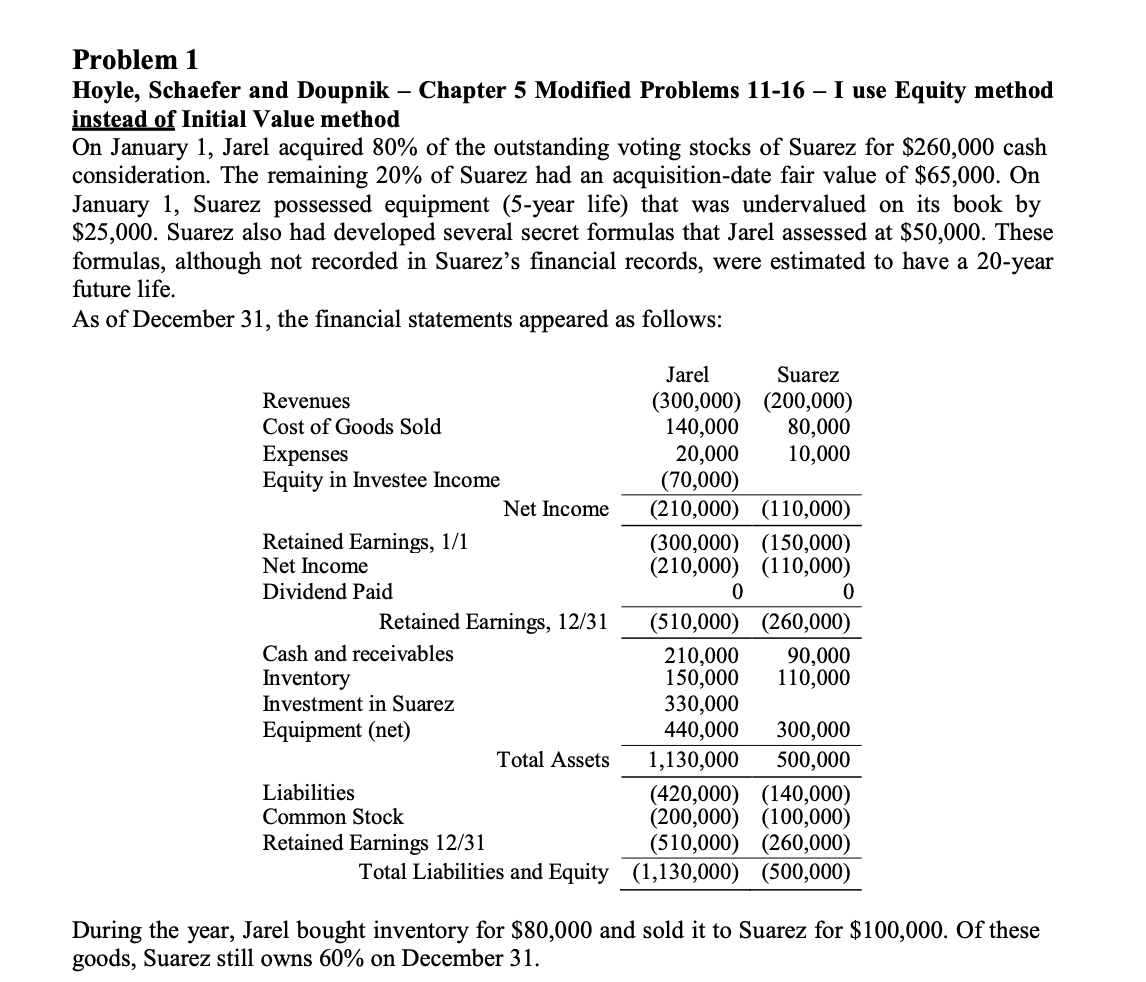
Problem 1 Hoyle, Schaefer and Doupnik - Chapter 5 Modified Problems 11-16 - I use Equity method instead of Initial Value method On January 1, Jarel acquired 80% of the outstanding voting stocks of Suarez for $260,000 cash consideration. The remaining 20% of Suarez had an acquisition-date fair value of $65,000. On January 1, Suarez possessed equipment (5-year life) that was undervalued on its book by $25,000. Suarez also had developed several secret formulas that Jarel assessed at $50,000. These formulas, although not recorded in Suarez's financial records, were estimated to have a 20-year future life. As of December 31, the financial statements appeared as follows: Jarel Suarez Revenues (300,000) (200,000) Cost of Goods Sold 140,000 80,000 Expenses 20,000 10,000 Equity in Investee Income (70,000) Net Income (210,000) (110,000) Retained Earnings, 1/1 (300,000) (150,000) Net Income (210,000) (110,000) Dividend Paid Retained Earnings, 12/31 (510,000) (260,000) Cash and receivables 210,000 90,000 Inventory 150,000 110,000 Investment in Suarez 330,000 Equipment (net) 440,000 300,000 Total Assets 1,130,000 500,000 Liabilities (420,000) (140,000) Common Stock (200,000) (100,000) Retained Earnings 12/31 (510,000) (260,000) Total Liabilities and Equity (1,130,000) (500,000) During the year, Jarel bought inventory for $80,000 and sold it to Suarez for $100,000. Of these goods, Suarez still owns 60% on December 31
Step by Step Solution
There are 3 Steps involved in it

Get step-by-step solutions from verified subject matter experts
 Study Help