







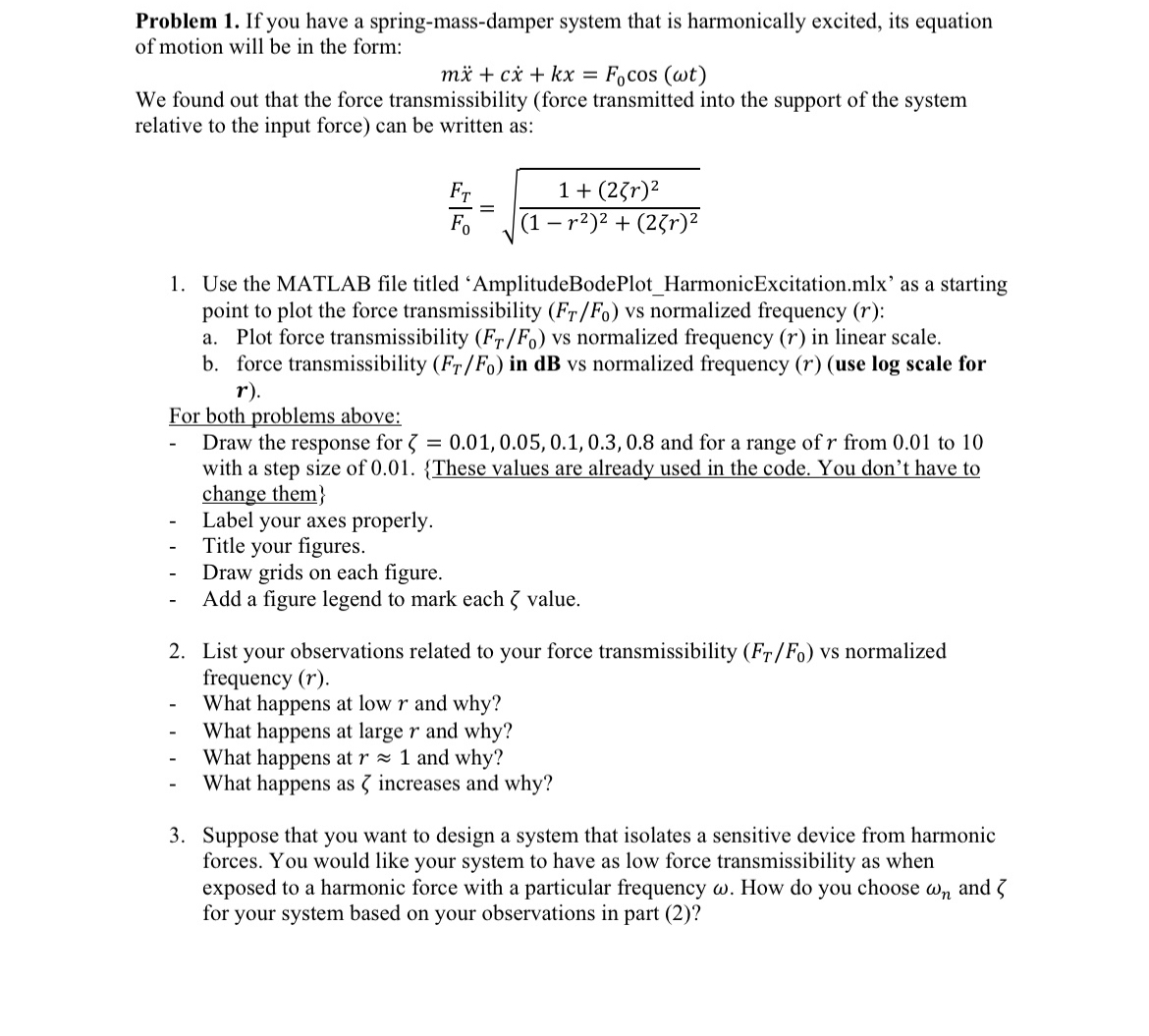
Question: Problem 1 . If you have a spring - mass - damper system that is harmonically excited, its equation of motion will be in the
Problem If you have a springmassdamper system that is harmonically excited, its equation of motion will be in the form:
We found out that the force transmissibility force transmitted into the support of the system relative to the input force can be written as:
Use the MATLAB file titled 'AmplitudeBodePlotHarmonicExcitation.mlx as a starting point to plot the force transmissibility vs normalized frequency :
a Plot force transmissibility vs normalized frequency in linear scale.
b force transmissibility in vs normalized frequency use log scale for
For both problems above:
Draw the response for and for a range of from to with a step size of These values are already used in the code. You don't have to change them
Label your axes properly.
Title your figures.
Draw grids on each figure.
Add a figure legend to mark each value.
List your observations related to your force transmissibility vs normalized frequency
What happens at low and why?
What happens at large and why?
What happens at ~~ and why?
What happens as increases and why?
Suppose that you want to design a system that isolates a sensitive device from harmonic forces. You would like your system to have as low force transmissibility as when exposed to a harmonic force with a particular frequency How do you choose and for your system based on your observations in part
Step by Step Solution
There are 3 Steps involved in it
1 Expert Approved Answer
Step: 1 Unlock

Question Has Been Solved by an Expert!
Get step-by-step solutions from verified subject matter experts
Step: 2 Unlock
Step: 3 Unlock
 Study Help