







Question: Problem 1. In most of the utility maximization problems we encounter in this course, the solution is interior. This means that a strictly positive quantity
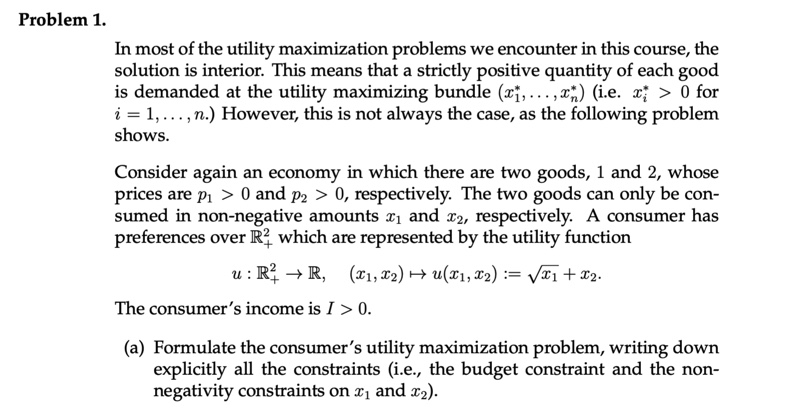
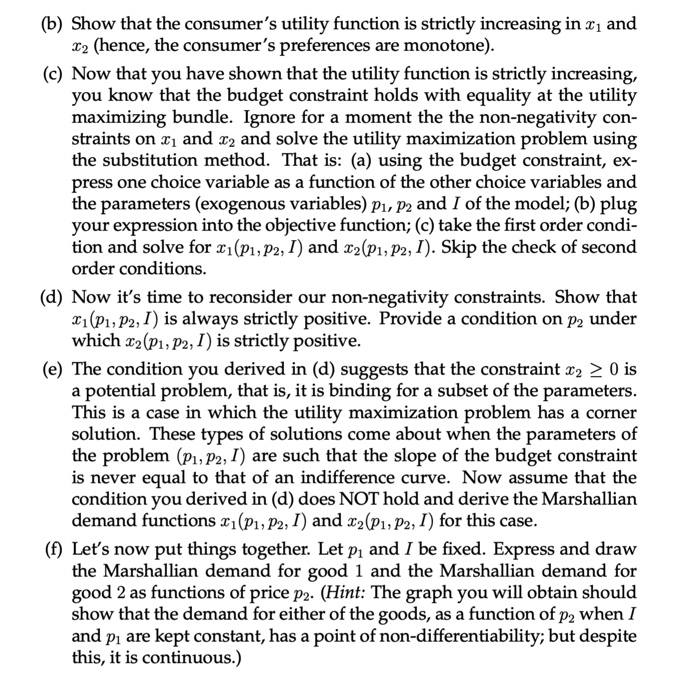
Problem 1. In most of the utility maximization problems we encounter in this course, the solution is interior. This means that a strictly positive quantity of each good is demanded at the utility maximizing bundle (x], ...,x,,) (i.e. x; > 0 for i = 1, ..., n.) However, this is not always the case, as the following problem shows. Consider again an economy in which there are two goods, 1 and 2, whose prices are p1 > 0 and p2 > 0, respectively. The two goods can only be con- sumed in non-negative amounts , and 12, respectively. A consumer has preferences over R? which are represented by the utility function u : R - R, (X1, 12) , u(X1, 12) := VII+12. The consumer's income is I > 0. (a) Formulate the consumer's utility maximization problem, writing down explicitly all the constraints (i.e., the budget constraint and the non- negativity constraints on r, and $2).(b) Show that the consumer's utility function is strictly increasing in r, and 12 (hence, the consumer's preferences are monotone). (c) Now that you have shown that the utility function is strictly increasing, you know that the budget constraint holds with equality at the utility maximizing bundle. Ignore for a moment the the non-negativity con- straints on 1 and 12 and solve the utility maximization problem using the substitution method. That is: (a) using the budget constraint, ex- press one choice variable as a function of the other choice variables and the parameters (exogenous variables) p1, p2 and I of the model; (b) plug your expression into the objective function; (c) take the first order condi- tion and solve for $1(P1, p2, I) and x2(p1, p2, I). Skip the check of second order conditions. (d) Now it's time to reconsider our non-negativity constraints. Show that X1(P1, P2, I) is always strictly positive. Provide a condition on p2 under which x2(P1, p2, I) is strictly positive. (e) The condition you derived in (d) suggests that the constraint x2 2 0 is a potential problem, that is, it is binding for a subset of the parameters. This is a case in which the utility maximization problem has a corner solution. These types of solutions come about when the parameters of the problem (P1, p2, /) are such that the slope of the budget constraint is never equal to that of an indifference curve. Now assume that the condition you derived in (d) does NOT hold and derive the Marshallian demand functions I1(P1, p2, I) and x2(P1, p2, I) for this case. (f) Let's now put things together. Let p, and I be fixed. Express and draw the Marshallian demand for good 1 and the Marshallian demand for good 2 as functions of price p2. (Hint: The graph you will obtain should show that the demand for either of the goods, as a function of p2 when I and p1 are kept constant, has a point of non-differentiability; but despite this, it is continuous.)
Step by Step Solution
There are 3 Steps involved in it

Get step-by-step solutions from verified subject matter experts
 Study Help