







Question: Problem 1 In the video lecture on Python functions we discussed variable positional arguments that use the special syntax *args to identify them. We can
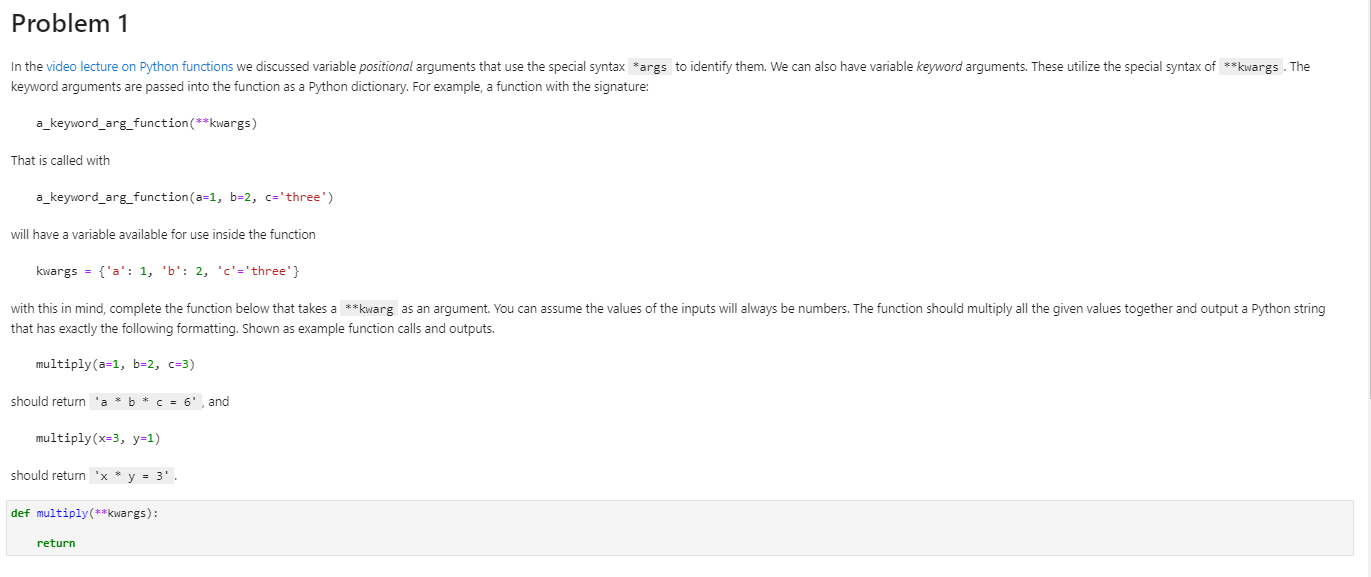
Problem 1 In the video lecture on Python functions we discussed variable positional arguments that use the special syntax *args to identify them. We can also have variable keyword arguments. These utilize the special syntax of **kwargs. The keyword arguments are passed into the function as a Python dictionary. For example, a function with the signature: a_keyword_arg_function(**kwargs) That is called with a_keyword_arg_function(a=1, b=2, c='three') will have a variable available for use inside the function kwargs = {'a': 1, 'b': 2, 'c'='three'} with this in mind, complete the function below that takes a **kwarg as an argument. You can assume the values of the inputs will always be numbers. The function should multiply all the given values together and output a Python string that has exactly the following formatting. Shown as example function calls and outputs. multiply(a=1, b=2, c=3) should return 'a * b* c = 6', and multiply(x=3, y=1) should return 'x * y = 3'. def multiply(**kwargs) : return
Step by Step Solution
There are 3 Steps involved in it

Get step-by-step solutions from verified subject matter experts
 Study Help