







Question: problem 1 is already solved before. Notice that , problem 2 is based on problem 1 Problem 1. (80 points) Consider the relational database defined
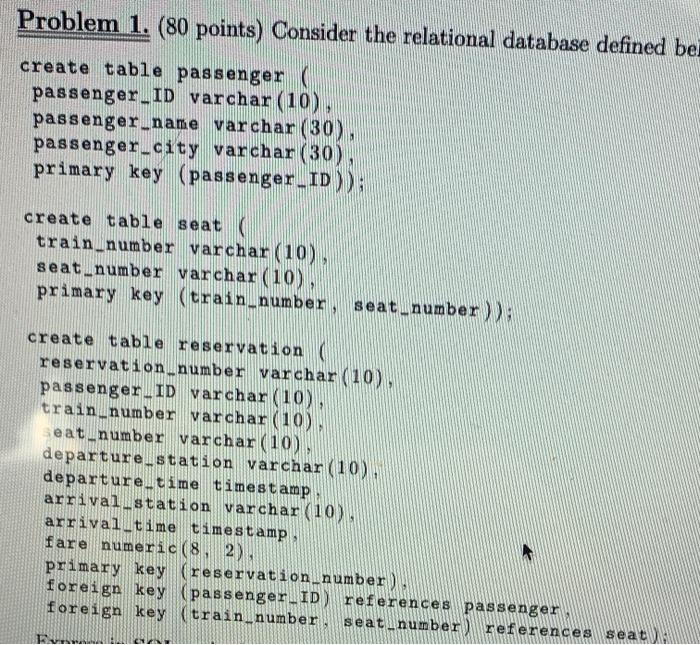
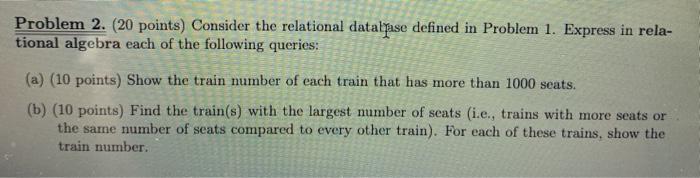
Problem 1. (80 points) Consider the relational database defined be create table passenger ( passenger.ID varchar (10), passenger_name varchar (30), passenger_city varchar (30) primary key (passenger ID)); create table seat ( train_number varchar (10), seat number varchar(10), primary key (train number seat number): create table reservation ( reservation_number varchar (10), passenger ID varchar (10), train number varchar (10) eat number varchar (10), departure station varchar (10), departure.time timestamp arrival station varchar(10), arrival time timestamp fare numeric ( 82) primary key (reservation number foreign key passenger-ID) references passenger foreign key (train_number, seat number) references seat HALL Problem 2. (20 points) Consider the relational datalyase defined in Problem 1. Express in rela- tional algebra each of the following queries: (a) (10 points) Show the train number of each train that has more than 1000 seats. (b) (10 points) Find the train(s) with the largest number of seats (i.e., trains with more seats or the same number of seats compared to every other train). For each of these trains, show the train number
Step by Step Solution
There are 3 Steps involved in it

Get step-by-step solutions from verified subject matter experts
 Study Help