







Question: Problem 1 is below in case that previous reference is needed: https://www.chegg.com/homework-help/questions-and-answers/-q30822107?trackid=jbqIIlQ5 Problem 2. We are going to generalize Problem 1 to two dimensions. Assume
Problem 1 is below in case that previous reference is needed:
https://www.chegg.com/homework-help/questions-and-answers/-q30822107?trackid=jbqIIlQ5
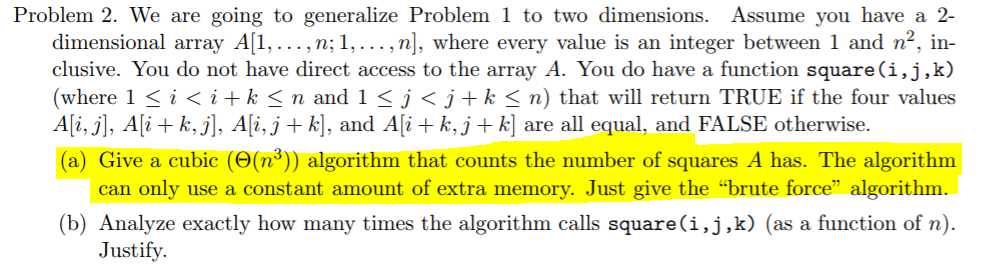
Problem 2. We are going to generalize Problem 1 to two dimensions. Assume you have a 2- dimensional array A[1,..., n; 1,...,n], where every value is an integer between 1 and n2, in clusive. You do not have direct access to the array A. You do have a function square(i,j,k) (where l it k n and i j j k-n) that will return TRUE if the four values Ali,j], Ali + k,j], Ali,j + k], and Ali +k,j +k] are all equal, and FALSE otherwise. (a) Give a cubic ((n3)) algorithm that counts the number of squares A has. The algorithm can only use a constant amount of extra memory. Just give the "brute force" algorithm. (b) Analyze exactly how many times the algorithm calls square(i,j,k) (as a function of n). Justify
Step by Step Solution
There are 3 Steps involved in it

Get step-by-step solutions from verified subject matter experts
 Study Help