



Question: Problem 1: Isothermal and adiabatic processes A. In an adiabatic process no heat is allowed to flow to or from the gas. You compress 1
Problem 1: Isothermal and adiabatic processes\ A. In an adiabatic process no heat is allowed to flow to or from the gas. You compress 1 mole of gas adiabatically from
0.42m^(3)to
0.12m^(3), starting at atmospheric pressure
(1\\\\times 10^(5)(Pa)).\ Will the gas temperature increase, decrease or stay constant during the process? Explain.\ Qualitatively sketch this process on the
PVdiagram at right.\ Determine the work done on the gas. (Hint: You'll need the final pressure)\ For this adiabatic compression, determine the signs of the following quantities:\
W=\
Q=\
\\\\Delta U=\
\\\\Delta T=\ B. In an isothermal process the temperature of the gas is kept constant. You compress 1 mole of gas isothermally from
0.42m^(3)to
0.12m^(3), starting at atmospheric pressure
(1\\\\times 10^(5)(Pa)).\ At each volume value do you expect the pressure of the gas in this isothermal process to be bigger, smaller, or equal to the gas pressure in the previous adiabatic one? Explain.\ Sketch this process on the
PVdiagram at right. Label appropriate values.\ Shade the area on the graph that corresponds to the work done on the gas.\ Determine the work done on the gas.\ For this isothermal compression, determine the signs of the following quantities:\
\\\\Delta T=\
\\\\Delta U=,W=\
Q= 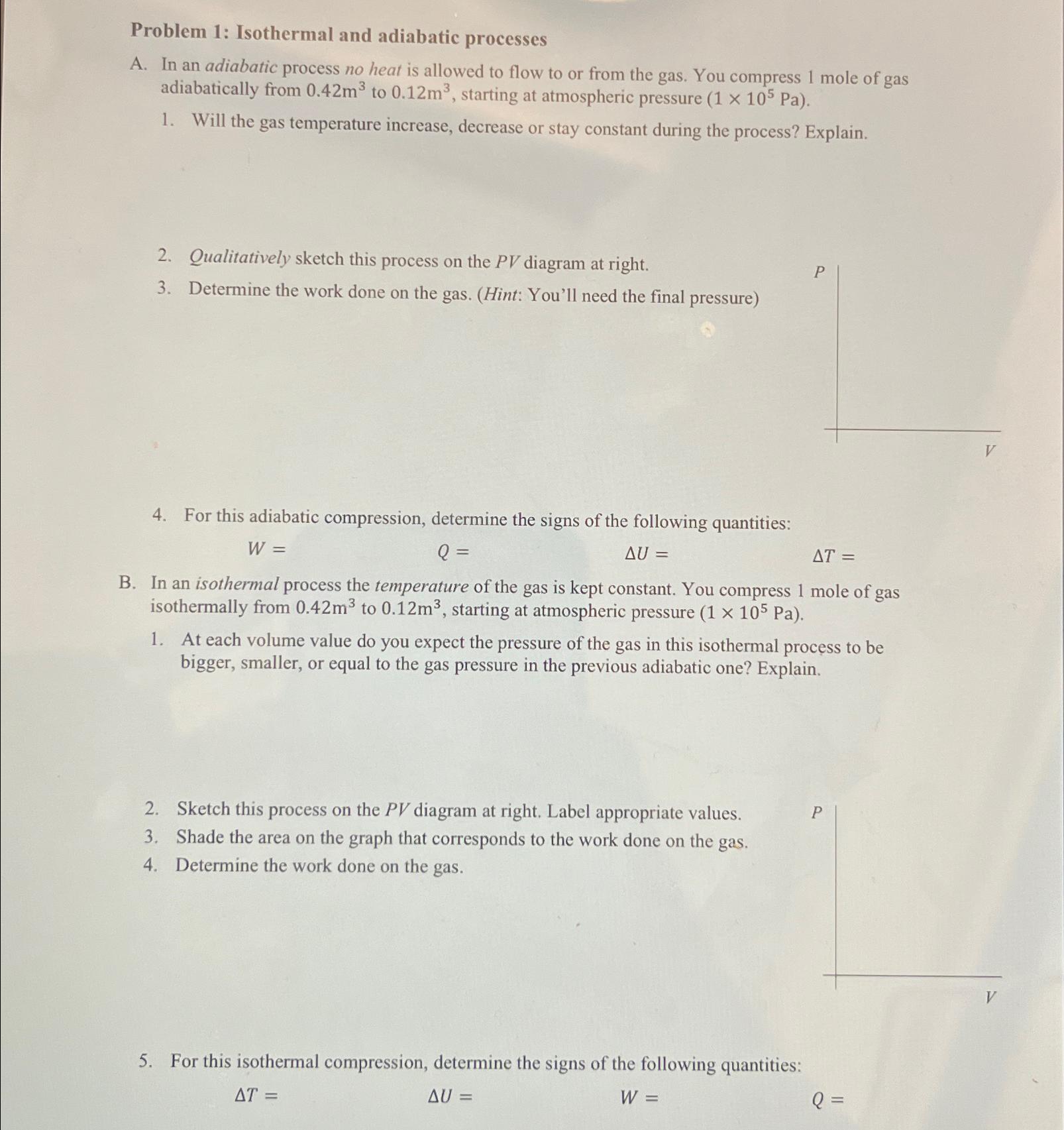
Problem 1: Isothermal and adiabatic processes A. In an adiabatic process no heat is allowed to flow to or from the gas. You compress 1 mole of gas adiabatically from 0.42m3 to 0.12m3, starting at atmospheric pressure (1105Pa). 1. Will the gas temperature increase, decrease or stay constant during the process? Explain. 2. Qualitatively sketch this process on the PV diagram at right. 3. Determine the work done on the gas. (Hint: You'll need the final pressure) 4. For this adiabatic compression, determine the signs of the following quantities: W= Q= U= T= B. In an isothermal process the temperature of the gas is kept constant. You compress 1 mole of gas isothermally from 0.42m3 to 0.12m3, starting at atmospheric pressure (1105Pa). 1. At each volume value do you expect the pressure of the gas in this isothermal process to be bigger, smaller, or equal to the gas pressure in the previous adiabatic one? Explain. 2. Sketch this process on the PV diagram at right. Label appropriate values. 3. Shade the area on the graph that corresponds to the work done on the gas. 4. Determine the work done on the gas
Step by Step Solution
There are 3 Steps involved in it

Get step-by-step solutions from verified subject matter experts