







Question: Problem 1 It is often said that we now have more computing power in our pockets {on our smart phones} than the computer aboard Apollo
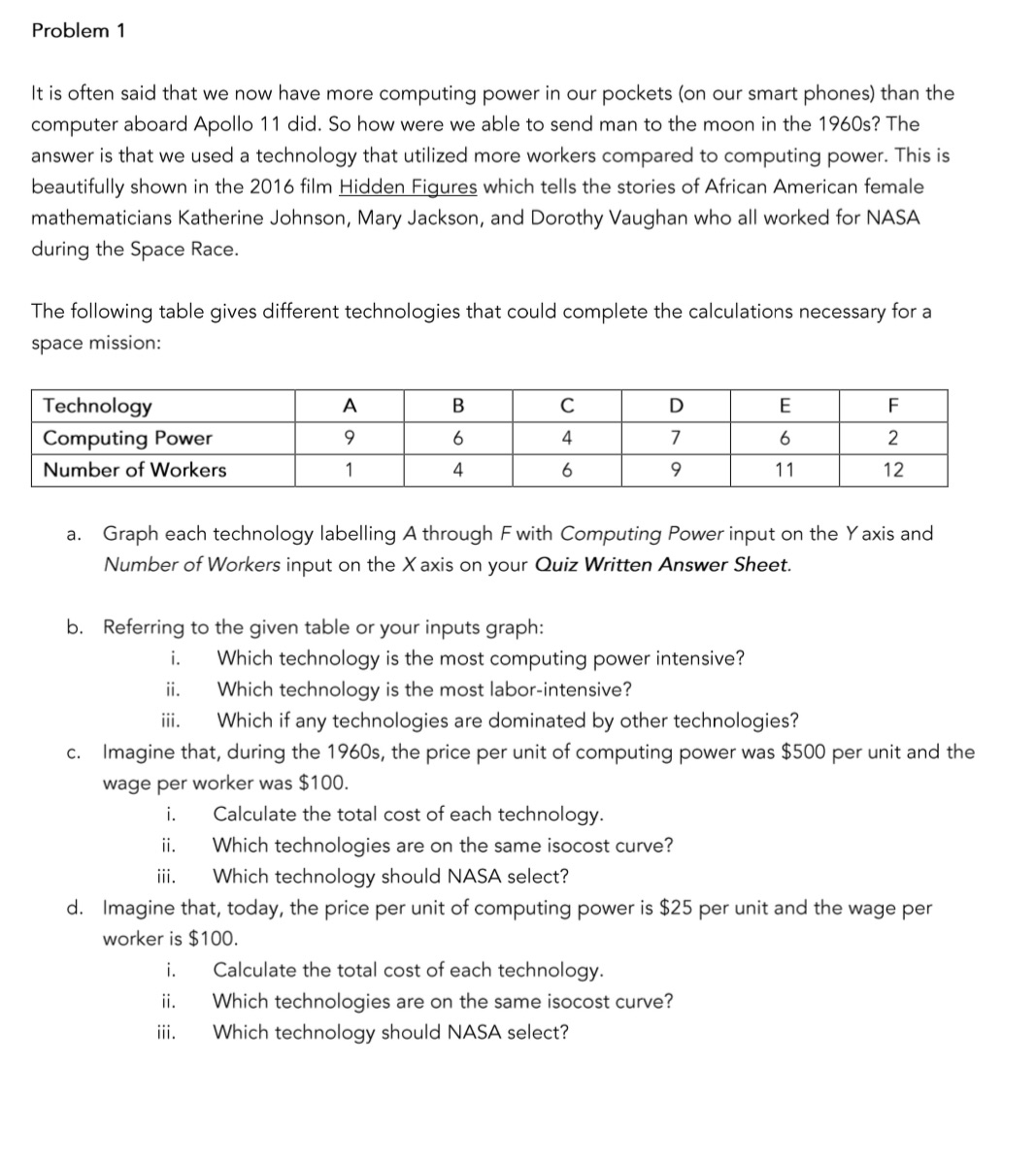
Problem 1 It is often said that we now have more computing power in our pockets {on our smart phones} than the computer aboard Apollo 11 did. So how were we able to send man to the moon in the 1960s? The answer is that we used a technology that utilized more workers compared to computing power. This is beautifully shown in the 2016 film Hidden Figures which tells the stories of African American female mathematicians Katherine Johnson, Mary Jackson, and Dorothy Vaughan who all worked for NASA during the Space Race. The following table gives different technologies that could complete the calculations necessary for a space mission: Technology \"nuI. Number of Workers a. Graph each technology labelling A through Fwith Computing Power input on the Yaxis and Number of Workers input on the Xaxis on your Quiz Written Answer Sheet. b. Referring to the given table or your inputs graph: i. Which technology is the most computing power intensive? ii. Which technology is the most labor-intensive? iii. Which if any technologies are dominated by other technologies? c. Imagine that, during the 19605, the price per unit of computing power was $500 per unit and the wage per worker was $100. i. Calculate the total cost of each technology. ii. Which technologies are on the same isocost curve? iii. Which technology shOuld NASA select? d. Imagine that, today, the price per unit of computing power is $25 per unit and the wage per worker is $100. i. Calculate the total cost of each technology. ii. Which technologies are on the same isocost curve? iii. Which technology should NASA select
Step by Step Solution
There are 3 Steps involved in it

Get step-by-step solutions from verified subject matter experts
 Study Help