







Question: Problem 1. Let E, E2, and E3 denote the events of excessive snowfall in the first, second, and third winters, respectively, from this fall. Statistical
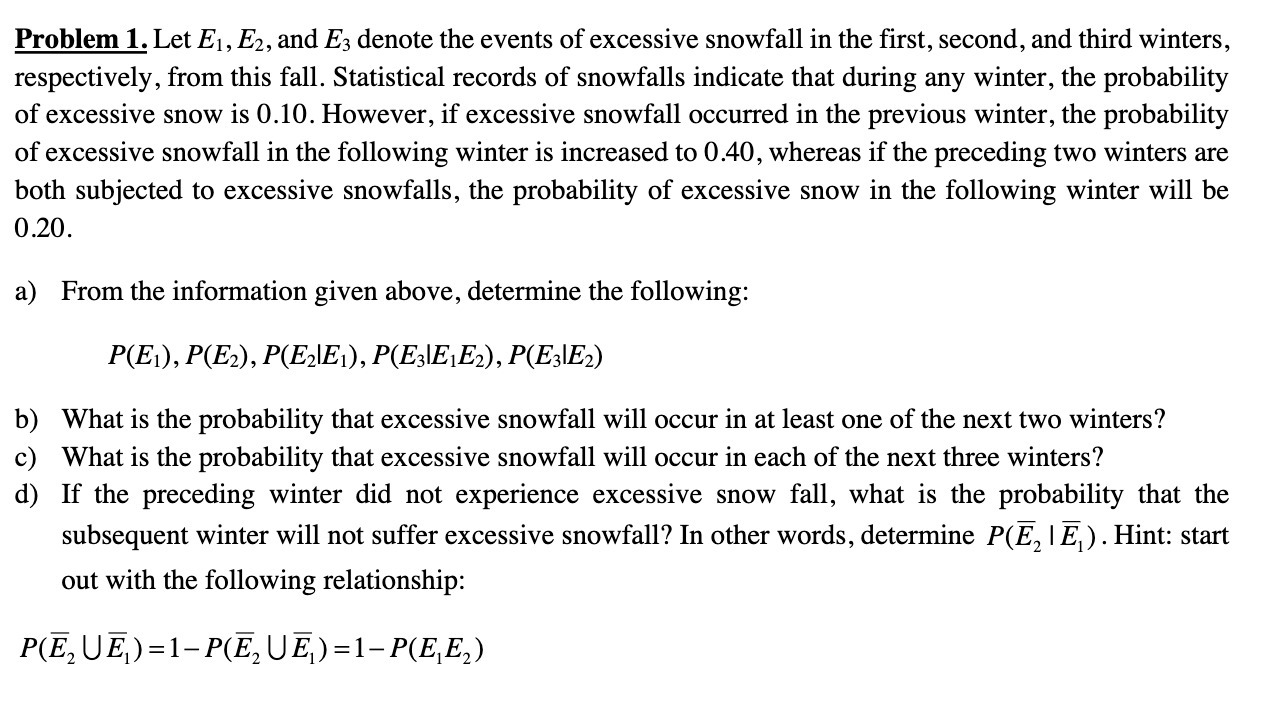
Problem 1. Let E, E2, and E3 denote the events of excessive snowfall in the first, second, and third winters, respectively, from this fall. Statistical records of snowfalls indicate that during any winter, the probability of excessive snow is 0.10. However, if excessive snowfall occurred in the previous winter, the probability of excessive snowfall in the following winter is increased to 0.40, whereas if the preceding two winters are both subjected to excessive snowfalls, the probability of excessive snow in the following winter will be 0.20. a) From the information given above, determine the following: P(E1), P(Eg), P(E2|E1), P(E3IE1E2), P(E3IE2) b) What is the probability that excessive snowfall will occur in at least one of the next two winters? c) What is the probability that excessive snowfall will occur in each of the next three winters? d) If the preceding winter did not experience excessive snow fall, what is the probability that the subsequent winter will not suffer excessive snowfall? In other words, determine NE: | E1) . Hint: start out with the following relationship: P(E2UE)=1_P(E2UE1)=1-P(E1E2)
Step by Step Solution
There are 3 Steps involved in it

Get step-by-step solutions from verified subject matter experts
 Study Help