







Question: Problem 1. Matching (25 points Consider the following problem Bipartite-Perfect-Matching Input Undirected bipartite graph G = (V E) with bipartition V where iL] = IR-n.
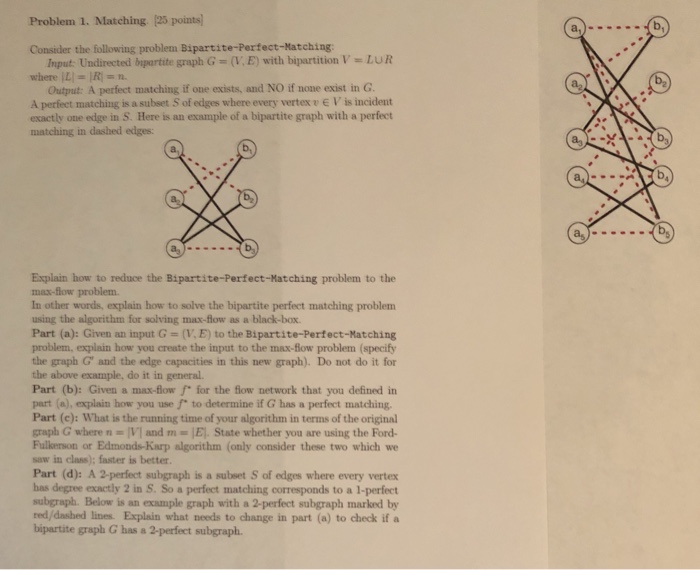
Problem 1. Matching (25 points Consider the following problem Bipartite-Perfect-Matching Input Undirected bipartite graph G = (V E) with bipartition V where iL] = IR-n. LUR Output: A perfect matching if one exists, and NO if none exist in G. A perfect matching is a subset S of edges where every vertexv V is incident exactly one edge in S. Here is an example of a bipartite graph with a perfect matching in dashed edges: Explain how to reduce the Bipartite-Perfect-Matching problem to the mas-flow problem In other words, explain how to solve the bipartite perfect matching problem using the algorithm for solving max-flow as a black-box. Part (a): Given an input G (VE) to the Bipartite-Perfect-Matching problem, explain how you create the input to the max-fow problem (specify the graph G and the edge capacities in this new graph). Do not do it for the above example, do it in general. Part (b): Given a max-flow f for the fow network that you defined in part (a), explain how you use f to determine if G has a perfect matching. Part (c): What is the running time of your algorithm in terms of the original graph G where n VI and m E). State whether you are using the Ford- Fullerson or Edmonds-Karp algorithm (only consider these two which we saw in class); faster is better. Part (d): A 2-perfect subgraph is a subset S of edges where every vertes has degree exactly 2 in S. So a perfect matching corresponds to a 1-perfect subgraph. Below is an exmple graph with a 2-perfect subgraph marked by red/dashed lines. Explain what needs to change in part (a) to check if a bipartite graph G has a 2-perfect subgraph Problem 1. Matching (25 points Consider the following problem Bipartite-Perfect-Matching Input Undirected bipartite graph G = (V E) with bipartition V where iL] = IR-n. LUR Output: A perfect matching if one exists, and NO if none exist in G. A perfect matching is a subset S of edges where every vertexv V is incident exactly one edge in S. Here is an example of a bipartite graph with a perfect matching in dashed edges: Explain how to reduce the Bipartite-Perfect-Matching problem to the mas-flow problem In other words, explain how to solve the bipartite perfect matching problem using the algorithm for solving max-flow as a black-box. Part (a): Given an input G (VE) to the Bipartite-Perfect-Matching problem, explain how you create the input to the max-fow problem (specify the graph G and the edge capacities in this new graph). Do not do it for the above example, do it in general. Part (b): Given a max-flow f for the fow network that you defined in part (a), explain how you use f to determine if G has a perfect matching. Part (c): What is the running time of your algorithm in terms of the original graph G where n VI and m E). State whether you are using the Ford- Fullerson or Edmonds-Karp algorithm (only consider these two which we saw in class); faster is better. Part (d): A 2-perfect subgraph is a subset S of edges where every vertes has degree exactly 2 in S. So a perfect matching corresponds to a 1-perfect subgraph. Below is an exmple graph with a 2-perfect subgraph marked by red/dashed lines. Explain what needs to change in part (a) to check if a bipartite graph G has a 2-perfect subgraph
Step by Step Solution
There are 3 Steps involved in it

Get step-by-step solutions from verified subject matter experts
 Study Help