







Question: Problem 1 Multiple Choice Problems (Check all that apply (20 pt) I. Which of the polymers may be recycled and why (2 pts) (a) Billiard
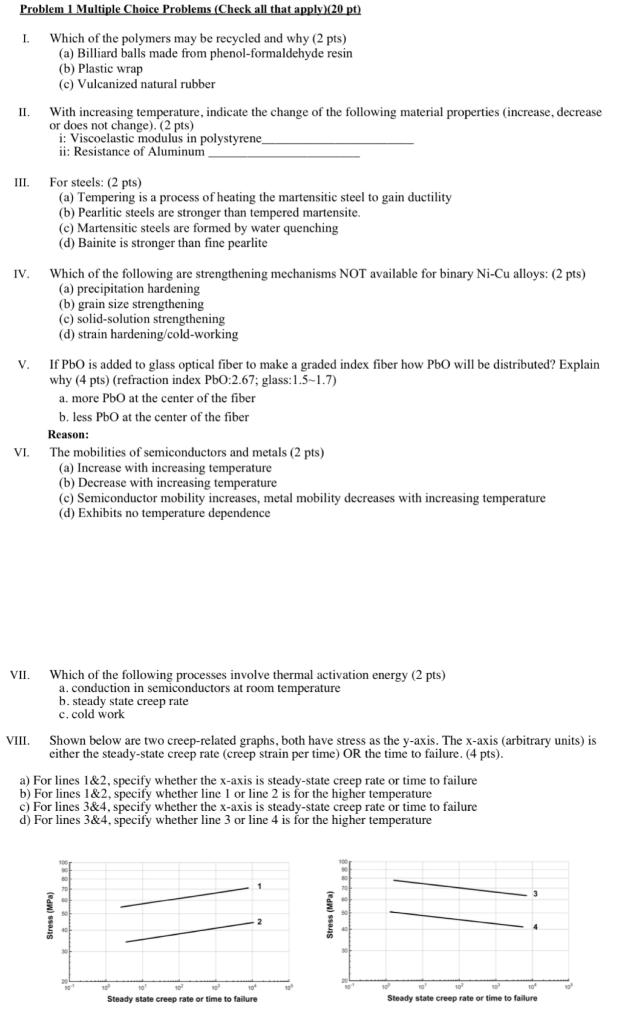
Problem 1 Multiple Choice Problems (Check all that apply (20 pt) I. Which of the polymers may be recycled and why (2 pts) (a) Billiard balls made from phenol-formaldehyde resin (b) Plastic wrap (c) Vulcanized natural rubber With increasing temperature, indicate the change of the following material properties (increase, decrease or does not change). (2 pts) i: Viscoelastic modulus in polystyrene_ ii: Resistance of Aluminum II. III. IV. For steels: (2 pts) (a) Tempering is a process of heating the martensitic steel to gain ductility (b) Pearlitic steels are stronger than tempered martensite. (c) Martensitic steels are formed by water quenching (d) Bainite is stronger than fine pearlite Which of the following are strengthening mechanisms NOT available for binary Ni-Cu alloys: (2 pts) (a) precipitation hardening (b) grain size strengthening (e) solid-solution strengthening (d) strain hardening/cold-working If PbO is added to glass optical fiber to make a graded index fiber how PbO will be distributed? Explain why (4 pts) (refraction index PbO:2.67; glass:1.5-1.7) a. more PbO at the center of the fiber b. less PbO at the center of the fiber Reason: The mobilities of semiconductors and metals (2 pts) (a) Increase with increasing temperature (b) Decrease with increasing temperature (c) Semiconductor mobility increases, metal mobility decreases with increasing temperature (d) Exhibits no temperature dependence V. VI. VII. Which of the following processes involve thermal activation energy (2 pts) a. conduction in semiconductors at room temperature b. steady state creep rate c. cold work VIII Shown below are two creep-related graphs, both have stress as the y-axis. The x-axis arbitrary units) is either the steady-state creep rate (creep strain per time) OR the time to failure. (4 pts). a) For lines 1&2, specify whether the x-axis is steady-state creep rate or time to failure b) For lines 1&2, specify whether line 1 or line 2 is for the higher temperature c) For lines 3&4. specify whether the x-axis is steady-state creep rate or time to failure d) For lines 3&4. specify whether line 3 or line 4 is for the higher temperature Stress (MPa) Stress (MPa) Steady state creep rate or time to failure Steady state creeprate or time to failure
Step by Step Solution
There are 3 Steps involved in it

Get step-by-step solutions from verified subject matter experts
 Study Help