







Question: Problem 1. Multiple Reactions Ethanol (CH3OH) can be produced commercially by the hydration of ethylene gas (CH): CH, (g) + H2O (g) CH-OH (9) Some
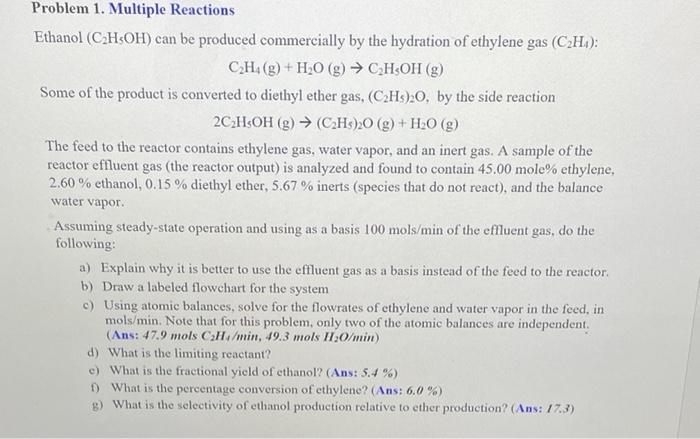
Problem 1. Multiple Reactions Ethanol (CH3OH) can be produced commercially by the hydration of ethylene gas (CH): CH, (g) + H2O (g) CH-OH (9) Some of the product is converted to diethyl ether gas, (CH3)20, by the side reaction 2C_HOH (g) (CH3)20(g) + H2O(g) The feed to the reactor contains ethylene gas, water vapor, and an inert gas. A sample of the reactor effluent gas (the reactor output) is analyzed and found to contain 45.00 mole% ethylene, 2.60 % ethanol, 0.15 % diethyl ether, 5.67 % inerts (species that do not react), and the balance water vapor. Assuming steady-state operation and using as a basis 100 mols/min of the effluent gas, do the following: a) Explain why it is better to use the effluent gas as a basis instead of the feed to the reactor. b) Draw a labeled flowchart for the system c) Using atomic balances, solve for the flowrates of ethylene and water vapor in the feed in mols/min. Note that for this problem, only two of the atomic balances are independent. (Ans: 47.9 mols CH /min, 19.3 mols 1120/min) d) What is the limiting reactant? e) What is the fractional yield of ethanol? (Ans: 5.4%) 1) What is the percentage conversion of ethylene? (Ans: 6.0%) B) What is the selectivity of ethanol production relative to ether production? (Ans: 17.3)
Step by Step Solution
There are 3 Steps involved in it

Get step-by-step solutions from verified subject matter experts
 Study Help