







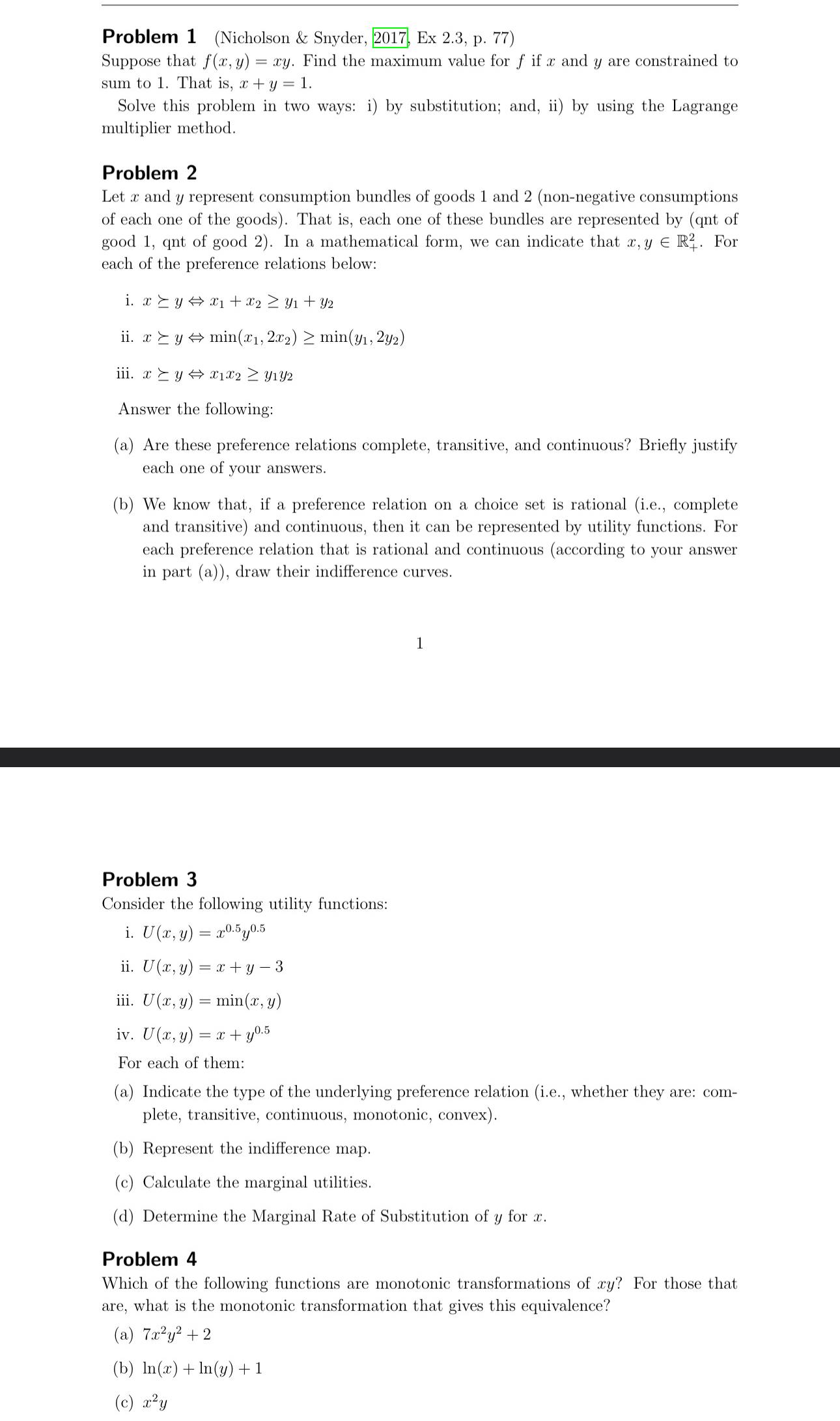
Question: Problem 1 ( Nicholson & Snyder, 2 0 1 7 , Ex 2 . 3 , p . 7 7 ) Suppose that f (
Problem Nicholson & Snyder, Ex p
Suppose that Find the maximum value for if and are constrained to sum to That is
Solve this problem in two ways: i by substitution; and, ii by using the Lagrange multiplier method.
Problem
Let and represent consumption bundles of goods and nonnegative consumptions of each one of the goods That is each one of these bundles are represented by qnt of good qut of good In a mathematical form, we can indicate that For each of the preference relations below:
i
iiminmin
iii.
Answer the following:
a Are these preference relations complete, transitive, and continuous? Briefly justify each one of your answers.
b We know that, if a preference relation on a choice set is rational ie complete and transitive and continuous, then it can be represented by utility functions. For each preference relation that is rational and continuous according to your answer in part a draw their indifference curves.
Problem
Consider the following utility functions:
i
ii
iii. min
iv
For each of them:
a Indicate the type of the underlying preference relation ie whether they are: complete, transitive, continuous, monotonic, convex
b Represent the indifference map.
c Calculate the marginal utilities.
d Determine the Marginal Rate of Substitution of for
Problem
Which of the following functions are monotonic transformations of For those that are, what is the monotonic transformation that gives this equivalence?
a
b
c
Step by Step Solution
There are 3 Steps involved in it
1 Expert Approved Answer
Step: 1 Unlock

Question Has Been Solved by an Expert!
Get step-by-step solutions from verified subject matter experts
Step: 2 Unlock
Step: 3 Unlock
 Study Help