







Question: Problem 1 : Optimal String Segmentation with Constraints You are given a long string ( S ) and a list of forbidden substrings
Problem : Optimal String Segmentation with Constraints
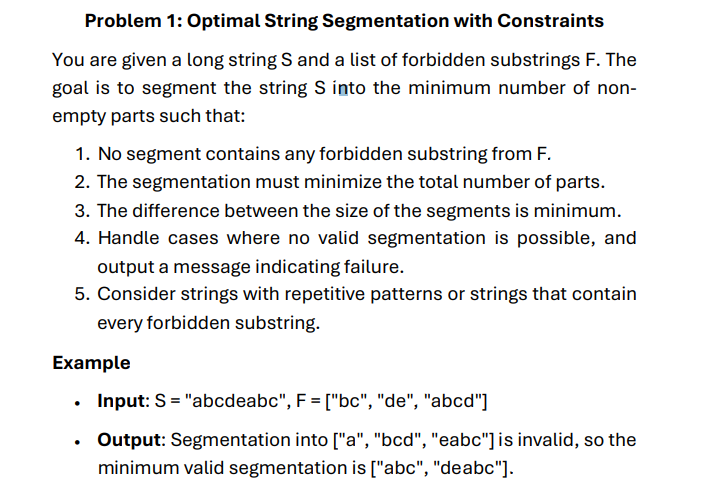
You are given a long string S and a list of forbidden substrings F The goal is to segment the string S into the minimum number of nonempty parts such that:
No segment contains any forbidden substring from F
The segmentation must minimize the total number of parts.
The difference between the size of the segments is minimum.
Handle cases where no valid segmentation is possible, and output a message indicating failure.
Consider strings with repetitive patterns or strings that contain every forbidden substring.
Example
cdot Input: S "abcdeabc", F bcde "abcd"
cdot Output: Segmentation into abcd "eabc" is invalid, so the minimum valid segmentation is abc "deabc"
Step by Step Solution
There are 3 Steps involved in it
1 Expert Approved Answer
Step: 1 Unlock

Question Has Been Solved by an Expert!
Get step-by-step solutions from verified subject matter experts
Step: 2 Unlock
Step: 3 Unlock
 Study Help