







Question: Problem 1: Probabilistic Project Scheduling (3.5 Points) To receive credit on this problem, you must upload your accompanying script, workbooks, etc. used to generate your
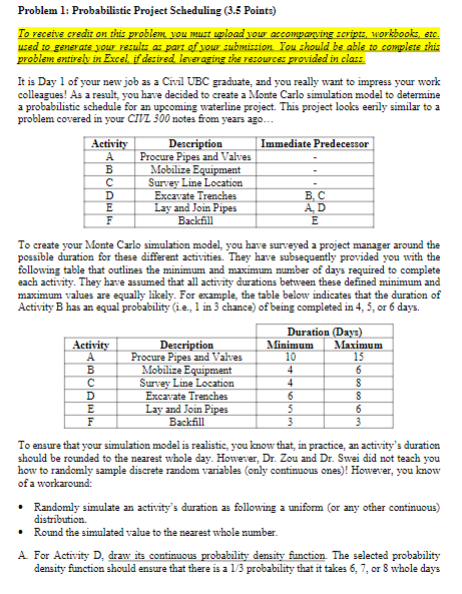
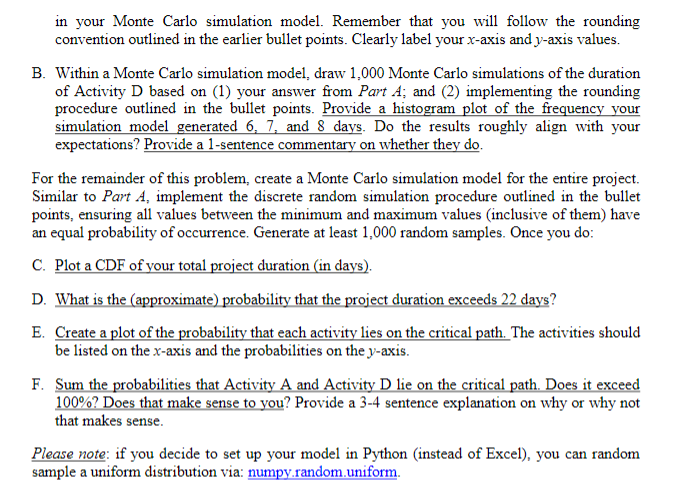
Problem 1: Probabilistic Project Scheduling (3.5 Points) To receive credit on this problem, you must upload your accompanying script, workbooks, etc. used to generate your results as part of your submission. You should be able to complete this problem entirely in Excel, if desired leveraging the resources provided in class. It is Day I of your new job as a Civil UBC graduate, and you really want to impress your work colleagues! As a result, you have decided to create a Monte Carlo simulation model to determine a probabilistic schedule for an upcoming waterline project. This project looks eerily similar to a problem covered in your CIIZ 300 notes from years ago... Activity Description Immediate Predecessor A Procure Pipes and Valves B Mobilize Equipment C Survey Line Location Excavate Trenches BC Lay and Join Pipes AD Backfill E To create your Monte Carlo simulation model, you have surveyed a project manager around the possible duration for these different activities. They have subsequently provided you with the following table that outlines the minimum and maximum number of days required to complete each activity. They have assumed that all activity durations between these defined minimum and maximum values are equally likely. For example, the table below indicates that the duration of Activity B has an equal probability (i.e., 1 in 3 chance) of being completed in 4, 5, or 6 days. Duration (Days) Activity Description Minimum Maximum A Procure Pipes and Valves 10 15 Mobilize Equipment 4 C Survey Line Location D Excavate Trenches 6 E Lay and Join Pipes 6 Backfill To ensure that your simulation model is realistic, you know that, in practice, an activity's duration should be rounded to the nearest whole day. However, Dr. Zou and Dr. Swei did not teach you how to randomly sample discrete random variables (only continuous ones)! However, you know of a workaround: Randomly simulate an activity's duration as following a uniform (or any other continuous) distribution. Round the simulated value to the nearest whole number. A For Activity D, draw its continuous probability density function. The selected probability density function should ensure that there is a 1/3 probability that it takes 6, 7, or $ whole daysin your Monte Carlo simulation model. Remember that you will follow the rounding convention outlined in the earlier bullet points. Clearly label your x-axis and y-axis values. B. Within a Monte Carlo simulation model, draw 1,000 Monte Carlo simulations of the duration of Activity D based on (1) your answer from Part A; and (2) implementing the rounding procedure outlined in the bullet points. Provide a histogram plot of the frequency your simulation model generated 6, 7, and 8 days. Do the results roughly align with your expectations? Provide a 1-sentence commentary on whether they do. For the remainder of this problem, create a Monte Carlo simulation model for the entire project. Similar to Part A, implement the discrete random simulation procedure outlined in the bullet points, ensuring all values between the minimum and maximum values (inclusive of them) have an equal probability of occurrence. Generate at least 1,000 random samples. Once you do: C. Plot a CDF of your total project duration (in days). D. What is the (approximate) probability that the project duration exceeds 22 days? E. Create a plot of the probability that each activity lies on the critical path. The activities should be listed on the x-axis and the probabilities on the y-axis. F. Sum the probabilities that Activity A and Activity D lie on the critical path. Does it exceed 100%? Does that make sense to you? Provide a 3-4 sentence explanation on why or why not that makes sense. Please note: if you decide to set up your model in Python (instead of Excel), you can random sample a uniform distribution via: numpy random.uniform
Step by Step Solution
There are 3 Steps involved in it

Get step-by-step solutions from verified subject matter experts
 Study Help