







Question: problem 1 problem 2 problem 3 Assume that your parents wanted to have $100,000 saved for college by your 18th birthday and they started saving
problem 1
problem 2
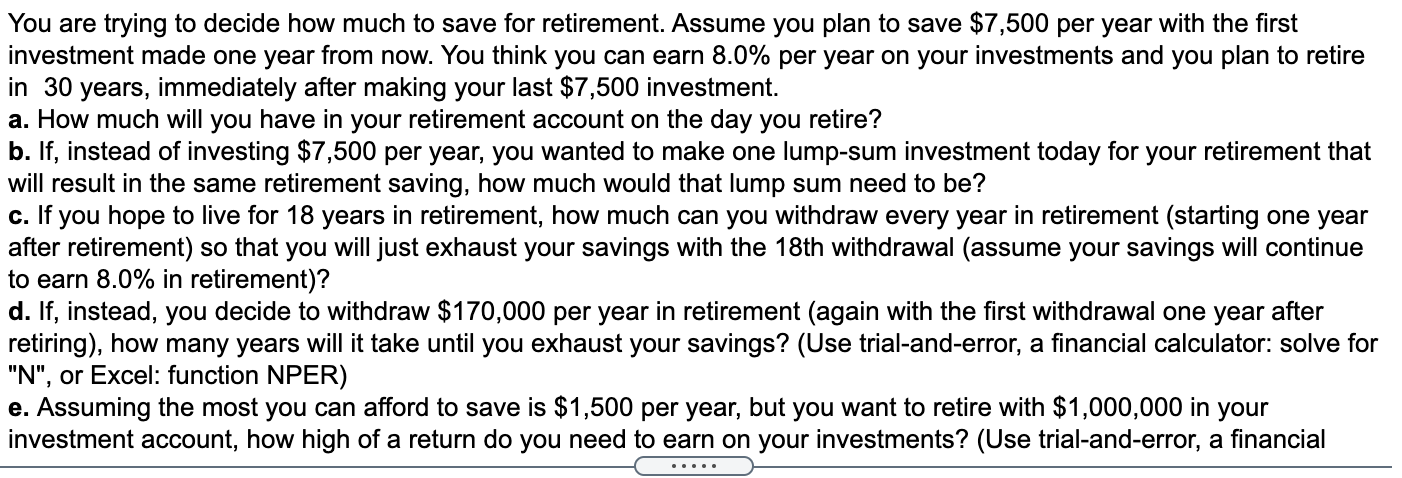
problem 3
Assume that your parents wanted to have $100,000 saved for college by your 18th birthday and they started saving on your first birthday. They saved the same amount each year on your birthday and earned 7.0% per year on their investments. a. How much would they have to save each year to reach their goal? b. If they think you will take five years instead of four to graduate and decide to have $140,000 saved just in case, how much would they have to save each year to reach their new goal? You are trying to decide how much to save for retirement. Assume you plan to save $7,500 per year with the first investment made one year from now. You think you can earn 8.0% per year on your investments and you plan to retire in 30 years, immediately after making your last $7,500 investment. a. How much will you have in your retirement account on the day you retire? b. If, instead of investing $7,500 per year, you wanted to make one lump-sum investment today for your retirement that will result in the same retirement saving, how much would that lump sum need to be? c. If you hope to live for 18 years in retirement, how much can you withdraw every year in retirement (starting one year after retirement) so that you will just exhaust your savings with the 18th withdrawal (assume your savings will continue to earn 8.0% in retirement)? d. If, instead, you decide to withdraw $170,000 per year in retirement (again with the first withdrawal one year after retiring), how many years will it take until you exhaust your savings? (Use trial-and-error, a financial calculator: solve for "N", or Excel: function NPER) e. Assuming the most you can afford to save is $1,500 per year, but you want to retire with $1,000,000 in your investment account, how high of a return do you need to earn on your investments? (Use trial-and-error, a financial A rich relative has bequeathed you a growing perpetuity. The first payment will occur in a year and will be $1,000. Each year after that, you will receive a payment on the anniversary of the last payment that is 7% larger than the last payment. This pattern of payments will go on forever. Assume that the interest rate is 14% per year. a. What is today's value of the bequest? b. What is the value of the bequest immediately after the first payment is made
Step by Step Solution
There are 3 Steps involved in it

Get step-by-step solutions from verified subject matter experts
 Study Help