





Question: Problem 1. (Second price auctions) We adopt exactly the same setup as Problem 5 on Problem Set 2: Suppose two bidders compete for a single
Problem 1. (Second price auctions) We adopt
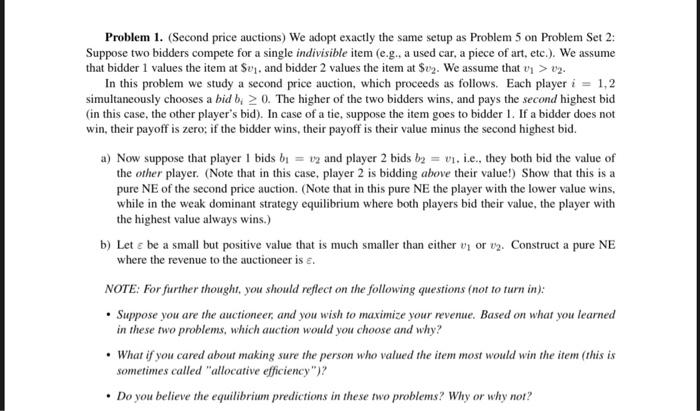
Problem 1. (Second price auctions) We adopt exactly the same setup as Problem 5 on Problem Set 2: Suppose two bidders compete for a single indivisible item (e.g., a used car, a piece of art, etc.). We assume that bidder 1 values the item at Svj. and bidder 2 values the item at $02. We assume that v1 > 09. In this problem we study a second price auction, which proceeds as follows. Each player i = 1,2 simultaneously chooses a bid by > 0. The higher of the two bidders wins, and pays the second highest bid (in this case, the other player's bid). In case of a tie, suppose the item goes to bidder 1. If a bidder does not win, their payoff is zero; if the bidder wins, their payoff is their value minus the second highest bid. a) Now suppose that player 1 bids bi = v2 and player 2 bids b2 = vi. i.e., they both bid the value of the other player. (Note that in this case, player 2 is bidding above their value!) Show that this is a pure NE of the second price auction. (Note that in this pure NE the player with the lower value wins, while in the weak dominant strategy equilibrium where both players bid their value, the player with the highest value always wins.) b) Let e be a small but positive value that is much smaller than either 0 or 12. Construct a pure NE where the revenue to the auctioneer is s. NOTE: For further thought, you should reflect on the following questions (not to turn in): Suppose you are the auctioneer, and you wish to maximize your revenue. Based on what you learned in these two problems, which auction would you choose and why? What if you cared about making sure the person who valued the item most would win the item (this is sometimes called "allocative efficiency")? Do you believe the equilibrium predictions in these two problems? Why or why not

Step by Step Solution

There are 3 Steps involved in it

1 Expert Approved Answer
Step: 1 Unlock

To solve this problem lets break it down into two parts as specified a Show that the given bidding strategy is a pure Nash Equilibrium Setup Bidder 1 ... View full answer

blur-text-image
Question Has Been Solved by an Expert!

Get step-by-step solutions from verified subject matter experts

Step: 2 Unlock
Step: 3 Unlock

Students Have Also Explored These Related General Management Questions!