







Question: Problem 1: Short answer (22pts) a. (5 pts) Using the Gibbs Phase Rule, determine how many independent variables must be specified for the following equilibrium
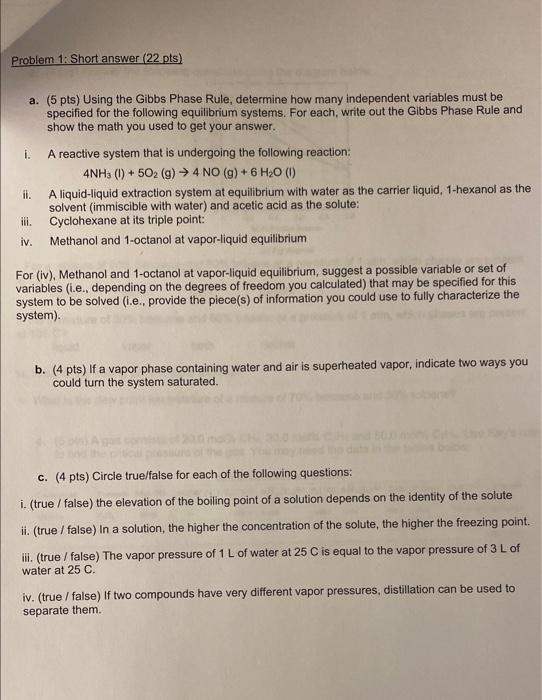
Problem 1: Short answer (22pts) a. (5 pts) Using the Gibbs Phase Rule, determine how many independent variables must be specified for the following equilibrium systems. For each, write out the Gibbs Phase Rule and show the math you used to get your answer. i. A reactive system that is undergoing the following reaction: 4NH3(l)+5O2(g)4NO(g)+6H2O(l) ii. A liquid-liquid extraction system at equilibrium with water as the carrier liquid, 1-hexanol as the solvent (immiscible with water) and acetic acid as the solute: iii. Cyclohexane at its triple point: iv. Methanol and 1-octanol at vapor-liquid equilibrium For (iv), Methanol and 1-octanol at vapor-liquid equilibrium, suggest a possible variable or set of variables (i.e., depending on the degrees of freedom you calculated) that may be specified for this system to be solved (i.e., provide the piece(s) of information you could use to fully characterize the system). b. (4 pts) If a vapor phase containing water and air is superheated vapor, indicate two ways you could turn the system saturated. c. (4 pts) Circle truelfalse for each of the following questions: i. (true / false) the elevation of the boiling point of a solution depends on the identity of the solute ii. (true / false) In a solution, the higher the concentration of the solute, the higher the freezing point. iii. (true / false) The vapor pressure of 1L of water at 25C is equal to the vapor pressure of 3L of water at 25C. iv. (true / false) If two compounds have very different vapor pressures, distillation can be used to separate them
Step by Step Solution
There are 3 Steps involved in it

Get step-by-step solutions from verified subject matter experts
 Study Help