







Question: Problem 1. SIR Epidemic Dynamics Control using IMC design (CMA 4). The goal of this problem is to apply Internal Model Control to design
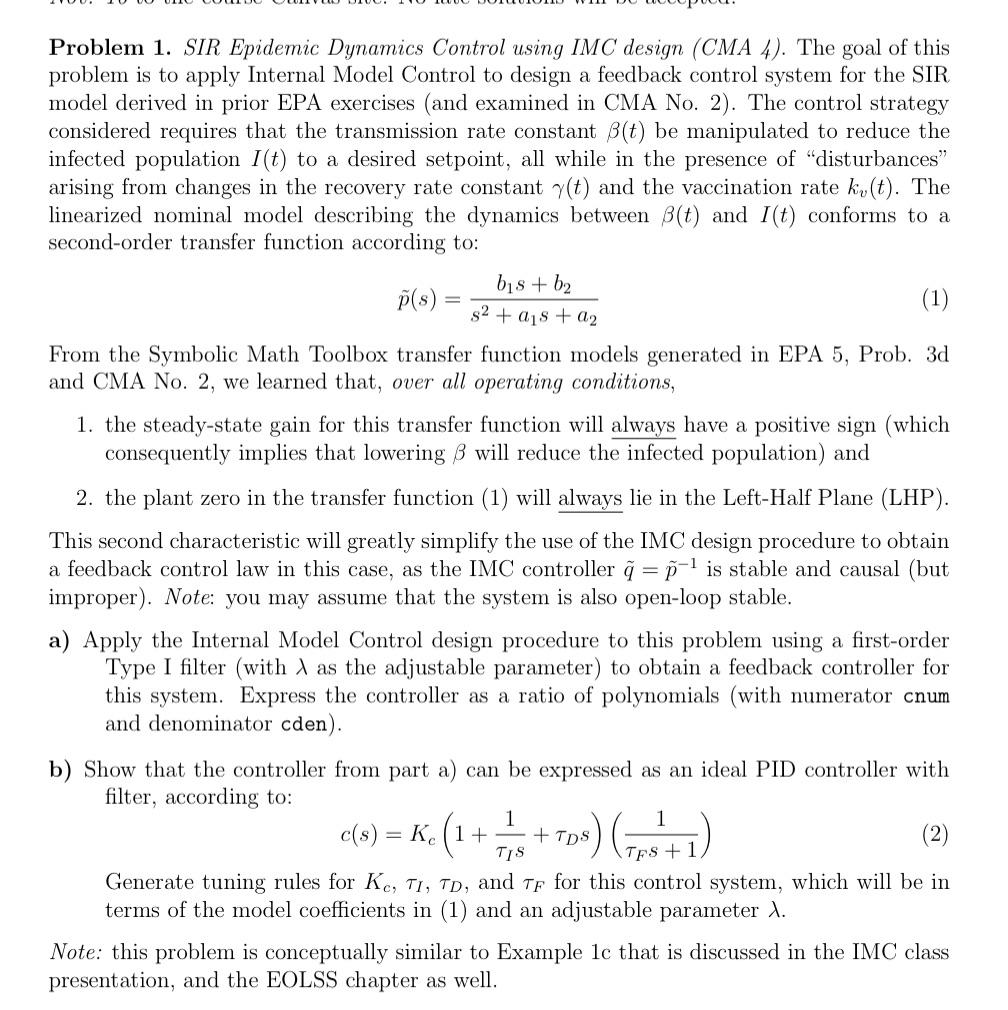
Problem 1. SIR Epidemic Dynamics Control using IMC design (CMA 4). The goal of this problem is to apply Internal Model Control to design a feedback control system for the SIR model derived in prior EPA exercises (and examined in CMA No. 2). The control strategy considered requires that the transmission rate constant (t) be manipulated to reduce the infected population I(t) to a desired setpoint, all while in the presence of "disturbances" arising from changes in the recovery rate constant y(t) and the vaccination rate k(t). The linearized nominal model describing the dynamics between B(t) and I(t) conforms to a second-order transfer function according to: p(s) = bs+b2 s+as+a2 (1) From the Symbolic Math Toolbox transfer function models generated in EPA 5, Prob. 3d and CMA No. 2, we learned that, over all operating conditions, 1. the steady-state gain for this transfer function will always have a positive sign (which consequently implies that lowering will reduce the infected population) and 2. the plant zero in the transfer function (1) will always lie in the Left-Half Plane (LHP). This second characteristic will greatly simplify the use of the IMC design procedure to obtain a feedback control law in this case, as the IMC controller q = p is stable and causal (but improper). Note: you may assume that the system is also open-loop stable. a) Apply the Internal Model Control design procedure to this problem using a first-order Type I filter (with A as the adjustable parameter) to obtain a feedback controller for this system. Express the controller as a ratio of polynomials (with numerator cnum and denominator cden). b) Show that the controller from part a) can be expressed as an ideal PID controller with filter, according to: c(s) = Ke (1+ 1 + TIS -TDS) (73+1) TFS (2) Generate tuning rules for Ke, TI, TD, and TF for this control system, which will be in terms of the model coefficients in (1) and an adjustable parameter A. Note: this problem is conceptually similar to Example 1c that is discussed in the IMC class presentation, and the EOLSS chapter as well.
Step by Step Solution
There are 3 Steps involved in it

Get step-by-step solutions from verified subject matter experts
 Study Help