



Question: Problem 1 Suppose that a monopolist faces a demand curve given by Q = 100 2P. The monopolist has a total cost function equal to
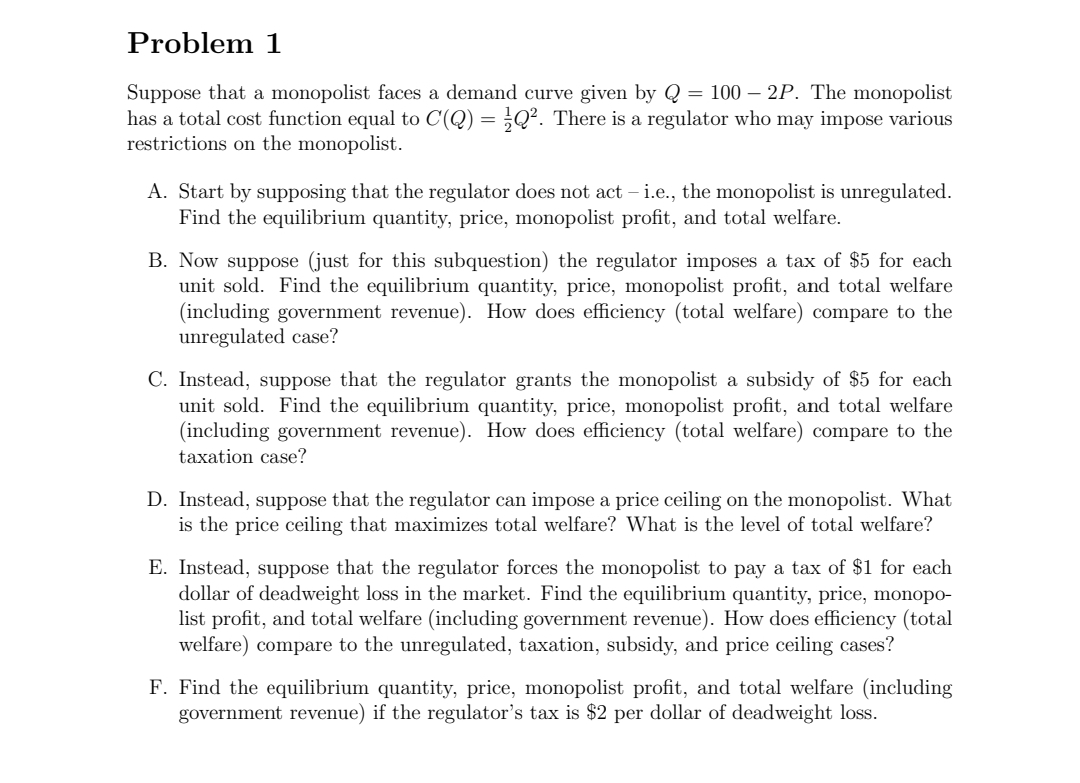
Problem 1 Suppose that a monopolist faces a demand curve given by Q = 100 2P. The monopolist has a total cost function equal to C(Q) = Q2. There is a regulator who may impose various restrictions on the monopolist. A. B. Start by supposing that the regulator does not act i.e., the monopolist is unregulated. Find the equilibrium quantity, price, monopolist prot, and total welfare. Now suppose (just for this subquestion} the regulator imposes a tax of $5 for each unit sold. Find the equilibrium quantity, price, monopolist prot, and total welfare (including government revenue). How does efciency (total welfare) compare to the unregulated case? Instead, suppose that the regulator grants the monopolist a subsidy of $5 for each unit sold. Find the equilibrium quantity, price, monopolist prot, and total welfare (including government revenue). How does efciency (total welfare) compare to the taxation case? Instead, suppose that the regulator can impose a price ceiling on the monopolist. \"That is the price ceiling that maximizes total welfare? What is the level of total welfare? Instead, suppose that the regulator forces the monopolist to pay a tax of $1 for each dollar of deadweight loss in the market. Find the equilibrium quantity, price, monopo~ list profit= and total welfare (including government revenue). How does efciency (total welfare) compare to the unregulated, taxation, subsidy, and price ceiling cases? Find the equilibrium quantity= price, monopolist prot, and total welfare (including government revenue) if the regulator's tax is $2 per dollar of deadweight loss
Step by Step Solution
There are 3 Steps involved in it

Get step-by-step solutions from verified subject matter experts