







Question: Problem 1. The following figure describes a representative consumer 's consumption of goods (C) and leisure (l). She has labour income w0L where w0 is
Problem 1. The following figure describes a representative consumer 's consumption of goods (C) and leisure (l). She has labour income w0L where w0 is the real wage and L is her hours of work. The time constraint is L + l = h where h is the total time endowment. The consumer's budget constraint is C wL + ? T with dividend income and a lump-sum tax T. Assume ? T > 0 and that her preferences over consumption and leisure satisfies strict monotonicity and strict convexity.
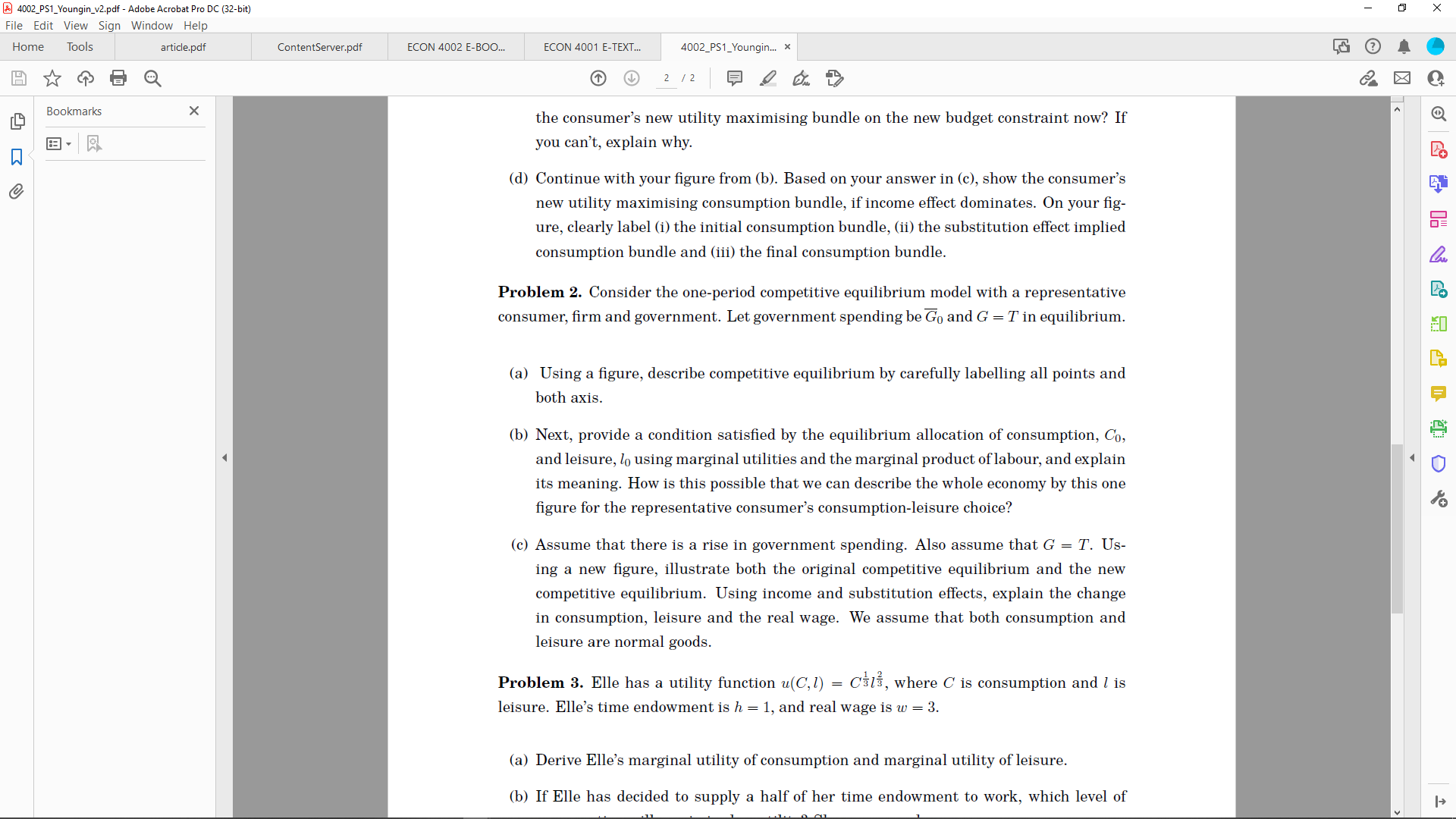
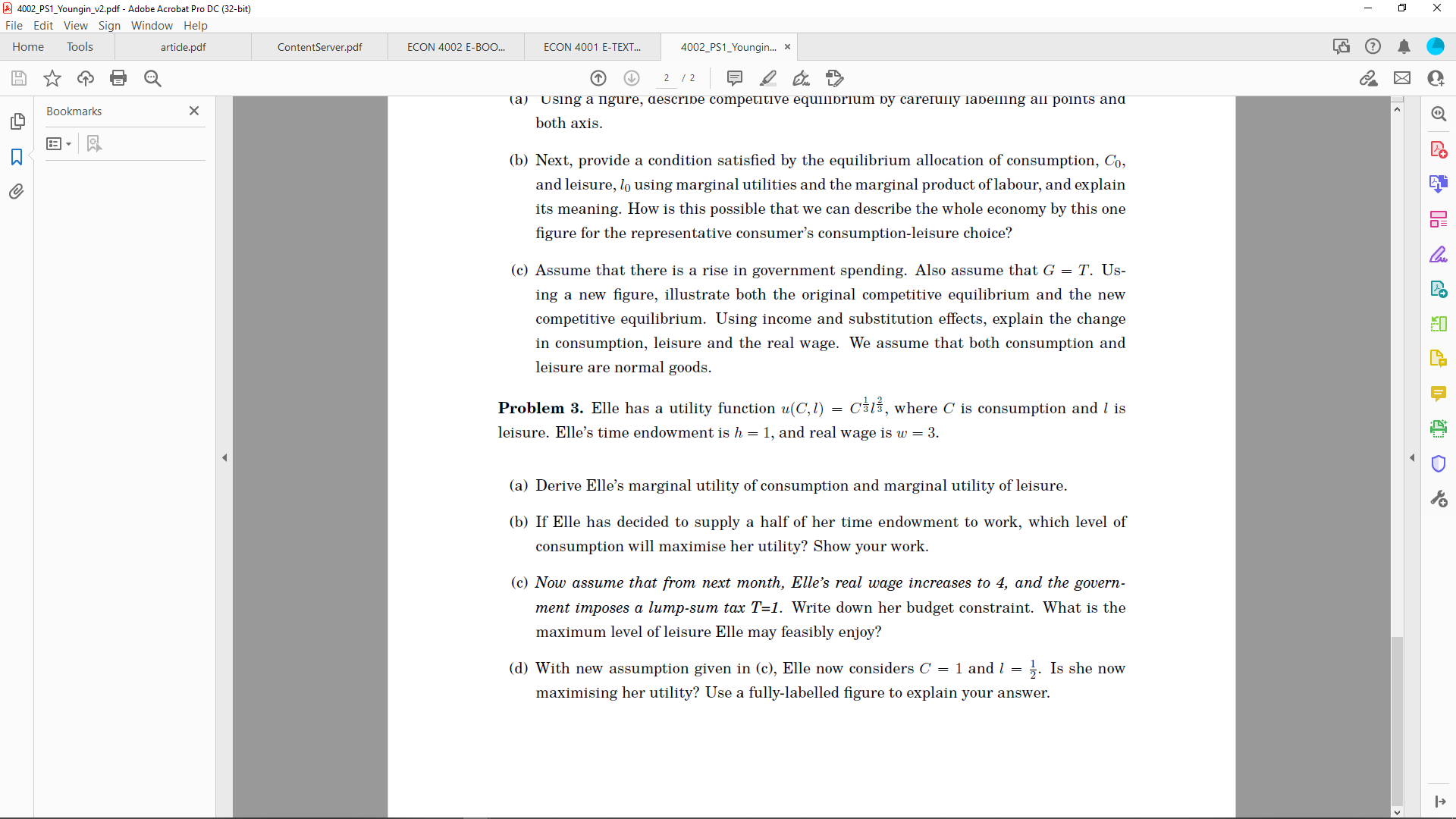
4002_PS1_Youngin_v2.pdf - Adobe Acrobat Pro DC (32-bit) X File Edit View Sign Window Help Home Tools article.pdf ContentServer.pdf ECON 4002 E-BOO. ECON 4001 E-TEXT.. 4002_PS1_Youngin.. x 1 1 1/2 5 0 06 27 Bookmarks X Problem 1. The following figure describes a representative consumer 's consumption of goods (C) and leisure (1). She has labour income wol where wo is the real wage and L is her hours of work. The time constraint is L + 1 = h where h is the total time endowment. The Co consumer's budget constraint is C' 0 and that her preferences over consumption and leisure satisfies strict monotonicity and strict convexity. woh+n - T (Co, Lo) slope : -wo h 0 (a) The consumer is currently choosing bundle (Co, lo). State the slope or tangency condi- tion that the bundle must satisfy to maximise the consumer's utility and explain its economic meaning. (b) Now the government decides to impose a positive proportional labour income tax. This means that the consumer's take home wage is now (1 -7)woL. There are no changes in other variables. How does the opportunity cost of consuming leisure change? On top of the given figure, draw a new budget constraint with its slope labelled. (c) Explain substitution effect and income effect on consumption and leisure generated by the rise in real wage, assuming that both C and / are normal goods. Can you determine4002_PS1_Youngin_v2.pdf - Adobe Acrobat Pro DC (32-bit) X File Edit View Sign Window Help Home Tools article.pdf ContentServer.pdf ECON 4002 E-BOO. ECON 4001 E-TEXT. 4002_PS1_Youngin... x Bookmarks X the consumer's new utility maximising bundle on the new budget constraint now? If you can't, explain why. Co (d) Continue with your figure from (b). Based on your answer in (c), show the consumer's new utility maximising consumption bundle, if income effect dominates. On your fig- ure, clearly label (i) the initial consumption bundle, (ii) the substitution effect implied consumption bundle and (iii) the final consumption bundle. Problem 2. Consider the one-period competitive equilibrium model with a representative consumer, firm and government. Let government spending be Go and G = T in equilibrium. (a) Using a figure, describe competitive equilibrium by carefully labelling all points and both axis. (b) Next, provide a condition satisfied by the equilibrium allocation of consumption, Co, and leisure, lo using marginal utilities and the marginal product of labour, and explain its meaning. How is this possible that we can describe the whole economy by this one figure for the representative consumer's consumption-leisure choice? (c) Assume that there is a rise in government spending. Also assume that G = T. Us- ing a new figure, illustrate both the original competitive equilibrium and the new competitive equilibrium. Using income and substitution effects, explain the change in consumption, leisure and the real wage. We assume that both consumption and leisure are normal goods. Problem 3. Elle has a utility function u(C, 1) = C313, where C is consumption and I is leisure. Elle's time endowment is h = 1, and real wage is w = 3. (a) Derive Elle's marginal utility of consumption and marginal utility of leisure. (b) If Elle has decided to supply a half of her time endowment to work, which level of4002_PS1_Youngin_v2.pdf - Adobe Acrobat Pro DC (32-bit) X File Edit View Sign Window Help Home Tools article.pdf ContentServer.pdf ECON 4002 E-BOO.. ECON 4001 E-TEXT.. 4002_PS1_Youngin... x (a) using a ngure, describe competitive equilibrium by carefully labelling all points and Bookmarks X both axis. Co (b) Next, provide a condition satisfied by the equilibrium allocation of consumption, Co, and leisure, lo using marginal utilities and the marginal product of labour, and explain its meaning. How is this possible that we can describe the whole economy by this one figure for the representative consumer's consumption-leisure choice? (c) Assume that there is a rise in government spending. Also assume that G = T. Us- ing a new figure, illustrate both the original competitive equilibrium and the new competitive equilibrium. Using income and substitution effects, explain the change in consumption, leisure and the real wage. We assume that both consumption and leisure are normal goods. Problem 3. Elle has a utility function u(C, 1) = Cals, where C is consumption and I is leisure. Elle's time endowment is h = 1, and real wage is w = 3. (a) Derive Elle's marginal utility of consumption and marginal utility of leisure. (b) If Elle has decided to supply a half of her time endowment to work, which level of consumption will maximise her utility? Show your work. (c) Now assume that from next month, Elle's real wage increases to 4, and the govern- ment imposes a lump-sum tax T=1. Write down her budget constraint. What is the maximum level of leisure Elle may feasibly enjoy? (d) With new assumption given in (c), Elle now considers C = 1 and I = -. Is she now maximising her utility? Use a fully-labelled figure to explain your
Step by Step Solution
There are 3 Steps involved in it

Get step-by-step solutions from verified subject matter experts
 Study Help