







Question: Problem 1 - Theory (10 points) a) Discuss the key similarity and difference between the RRM and the FEM. Sketch typical basis functions for these
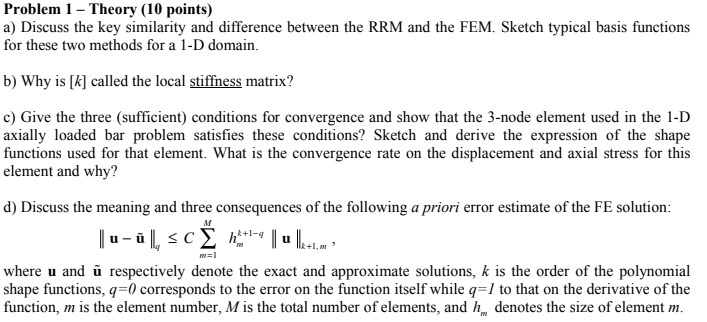
Problem 1 - Theory (10 points) a) Discuss the key similarity and difference between the RRM and the FEM. Sketch typical basis functions for these two methods for a 1-D domain. b) Why is [k] called the local stiffness matrix? c) Give the three (sufficient) conditions for convergence and show that the 3-node element used in the 1-D axially loaded bar problem satisfies these conditions? Sketch and derive the expression of the shape functions used for that element. What is the convergence rate on the displacement and axial stress for this element and why? d) Discuss the meaning and three consequences of the following a priori error estimate of the FE solution: where u and u respectively denote the exact and approximate solutions, k is the order of the polynomial shape functions, q-0 corresponds to the error on the function itself while q-1 to that on the derivative of the function, m is the element number, M is the total number of elements, and h denotes the size of element m. Problem 1 - Theory (10 points) a) Discuss the key similarity and difference between the RRM and the FEM. Sketch typical basis functions for these two methods for a 1-D domain. b) Why is [k] called the local stiffness matrix? c) Give the three (sufficient) conditions for convergence and show that the 3-node element used in the 1-D axially loaded bar problem satisfies these conditions? Sketch and derive the expression of the shape functions used for that element. What is the convergence rate on the displacement and axial stress for this element and why? d) Discuss the meaning and three consequences of the following a priori error estimate of the FE solution: where u and u respectively denote the exact and approximate solutions, k is the order of the polynomial shape functions, q-0 corresponds to the error on the function itself while q-1 to that on the derivative of the function, m is the element number, M is the total number of elements, and h denotes the size of element m
Step by Step Solution
There are 3 Steps involved in it

Get step-by-step solutions from verified subject matter experts
 Study Help