







Question: Problem 1 Two chambers are separated by a partition. One of the chambers is evacuated, and the other has a volume of 0.5 m and
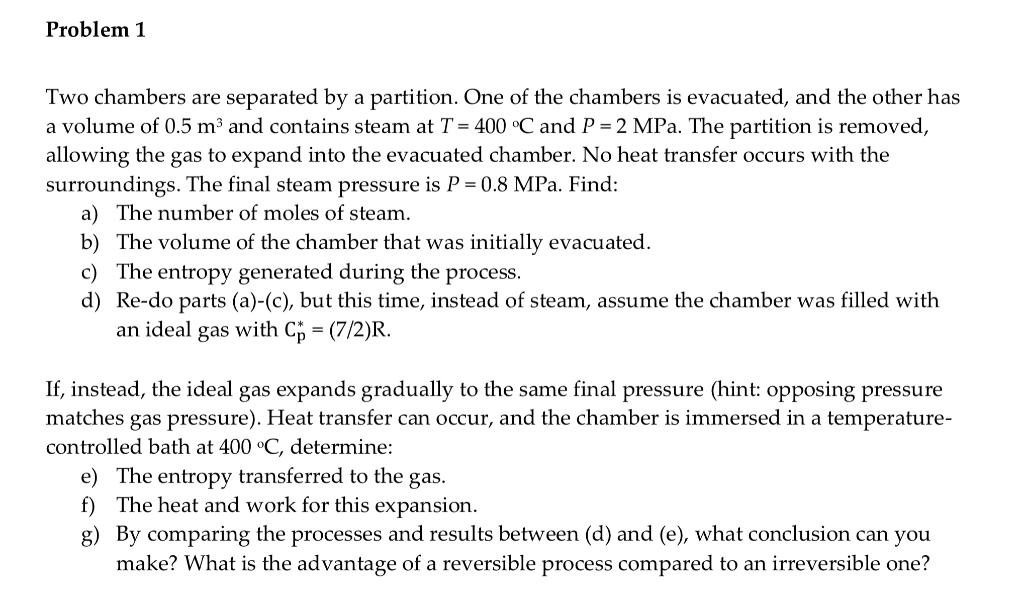
Problem 1 Two chambers are separated by a partition. One of the chambers is evacuated, and the other has a volume of 0.5 m and contains steam at T = 400 C and P = 2 MPa. The partition is removed, allowing the gas to expand into the evacuated chamber. No heat transfer occurs with the surroundings. The final steam pressure is P = 0.8 MPa. Find: a) The number of moles of steam. b) The volume of the chamber that was initially evacuated. c) The entropy generated during the process. d) Re-do parts (a)-(c), but this time, instead of steam, assume the chamber was filled with an ideal gas with Cp = (7/2)R. If, instead, the ideal gas expands gradually to the same final pressure (hint: opposing pressure matches gas pressure). Heat transfer can occur, and the chamber is immersed in a temperature- controlled bath at 400 C, determine: e) The entropy transferred to the gas. f) The heat and work for this expansion. g) By comparing the processes and results between (d) and (e), what conclusion can you make? What is the advantage of a reversible process compared to an irreversible one
Step by Step Solution
There are 3 Steps involved in it

Get step-by-step solutions from verified subject matter experts
 Study Help