







Question: Problem #1: Understanding the Basics At your pod, you've got a set of brass and aluminum cylinders. You should have a labmate fill the group's
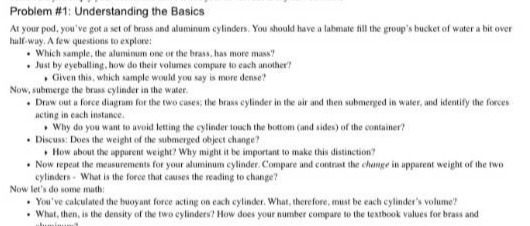
Problem #1: Understanding the Basics At your pod, you've got a set of brass and aluminum cylinders. You should have a labmate fill the group's bucket of water a bit over half-way. A few questions to explore: . Which sample, the aluminum one of the brass, has more mass" . Just by eyeballing, how do their volumes compare to each another'? . Given this, which sample would you say is more dense? Now, submerge the brass cylinder in the water. . Draw out a force diagram for the two cases; the brass cylinder in the air and then submerged in water, and identify the forces acting in each instance. . Why do you want to avoid letting the cylinder touch the bottom (and sides) of the container? . Discuss: Does the weight of the submerged object change? . How about the apparent weight? Why might it be important to make this distinction? . Now repeat the measurements for your aluminum cylinder Compare and contrast the change in apparent weight of the two cylinders - What is the force that causes the reading to change? Now let's do some math: . You've calculated the buoyant force acting on each cylinder. What, therefore, must be each cylinder's volume? . What, then, is the density of the two cylinders? How does your number compare to the textbook values for brass and
Step by Step Solution
There are 3 Steps involved in it

Get step-by-step solutions from verified subject matter experts
 Study Help