







Question: Problem 1 We are interested in factors that will affect infant birth weight (bw). One of the explanatory variables is the average number of eggs
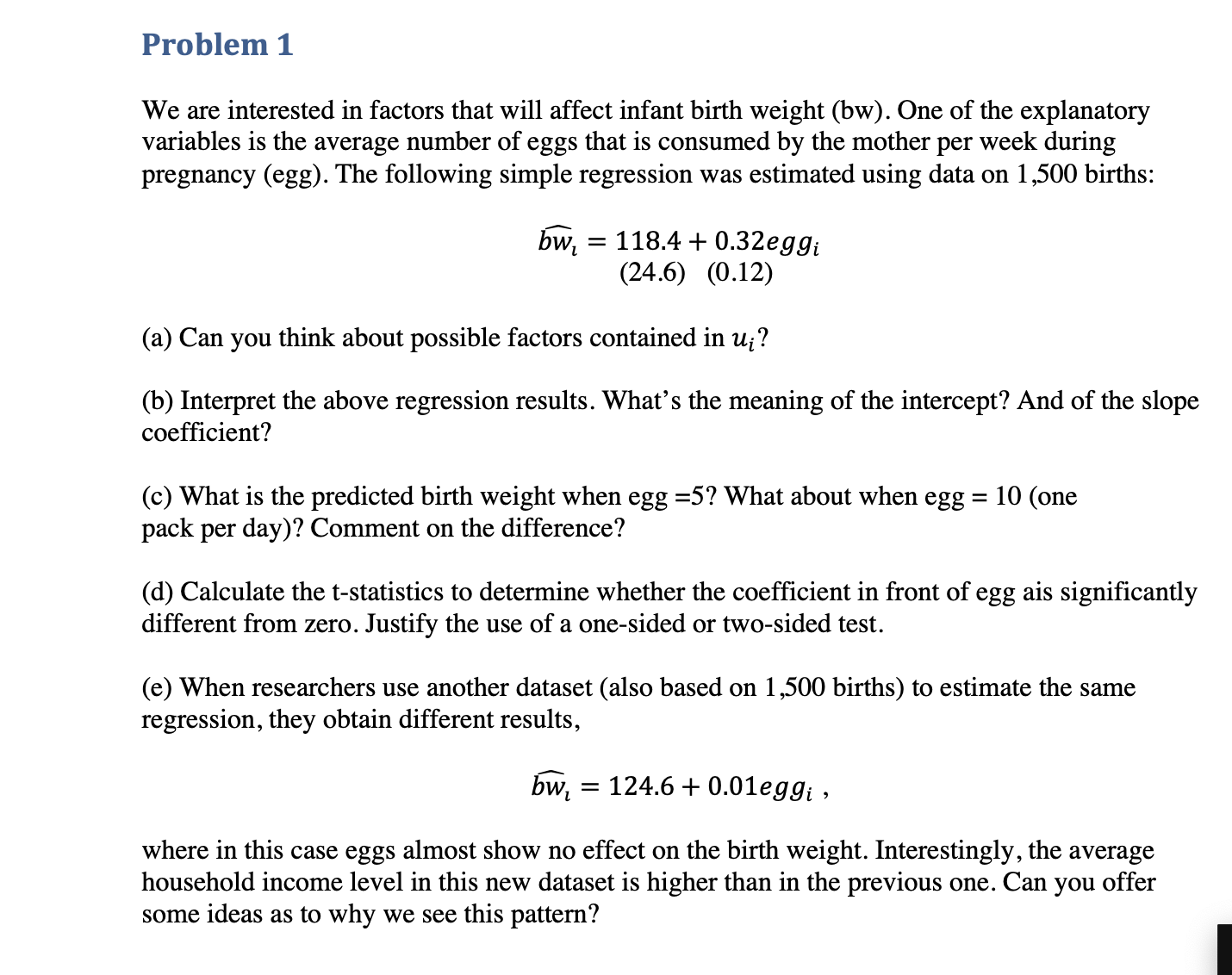
Problem 1 We are interested in factors that will affect infant birth weight (bw). One of the explanatory variables is the average number of eggs that is consumed by the mother per week during pregnancy (egg). The following simple regression was estimated using data on 1 ,500 births: 4. le = 118.4 + 0.32.9991- (24.6) (0.12) (a) Can you think about possible factors contained in ui? (b) Interpret the above regression results. What's the meaning of the intercept? And of the slope coefcient? (c) What is the predicted birth weight when egg =5? What about when egg = 10 (one pack per day)? Comment on the difference? (d) Calculate the t-statistics to determine whether the coefcient in front of egg ais signicantly different from zero. Justify the use of a one-sided or two-sided test. (e) When researchers use another dataset (also based on 1,500 births) to estimate the same regression, they obtain different results, A bwl = 124.6 + 0.01.9991- , where in this case eggs almost show no effect on the birth weight. Interestingly, the average household income level in this new dataset is higher than in the previous one. Can you offer some ideas as to why we see this pattern
Step by Step Solution
There are 3 Steps involved in it

Get step-by-step solutions from verified subject matter experts
 Study Help