







Question: Problem 1 Write the Assembly instructions required to initialize registers AX, BX, and CX with the decimal values 352, 457, 87. Then write the instruction
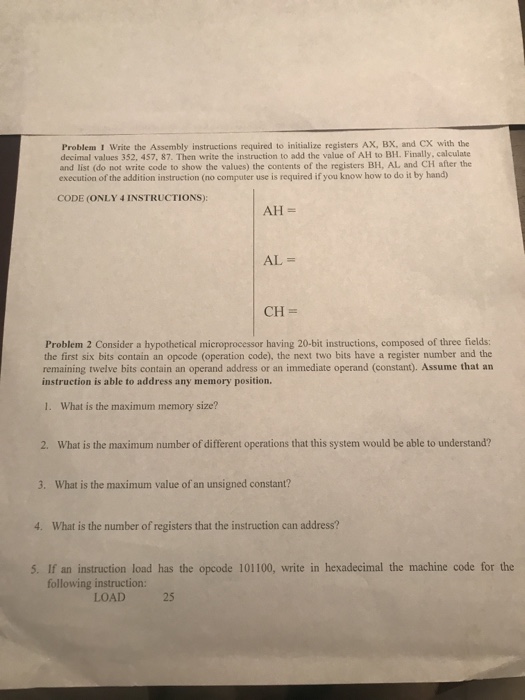
Problem 1 Write the Assembly instructions required to initialize registers AX, BX, and CX with the decimal values 352, 457, 87. Then write the instruction to add the value of AH to BH. Finally, calculate and list (do not write code to show the values) the contents of the registers BH, AL and CH after the execution of the addition instruction (no computer use is required if you know how to do it by hand) CODE (ONLY 4 INSTRUCTIONS): AL = Problem 2 Consider a hypothetical microprocessor having 20-bit instructions, composed of three fields: the first six bits contain an opcode (operation code), the next two bits have a register number and the remaining twelve bits contain an operand address or an immediate operand (constant). Assume that an instruction is able to address any memory position. 1. What is the maximum memory size? 2. What is the maximum number of different operations that this system would be able to understand? 3. What is the maximum value of an unsigned constant? 4. What is the number of registers that the instruction can address? 5. If an instruction load has the opcode 101100, write in hexadecimal the machine code for the following instruction: LOAD 25
Step by Step Solution
There are 3 Steps involved in it

Get step-by-step solutions from verified subject matter experts
 Study Help