



Question: Problem 1 You are discussing your retirement plan with Emma Li when she mentions that Maureen O'Brien, a representative from Toronto Financial Services, is visiting
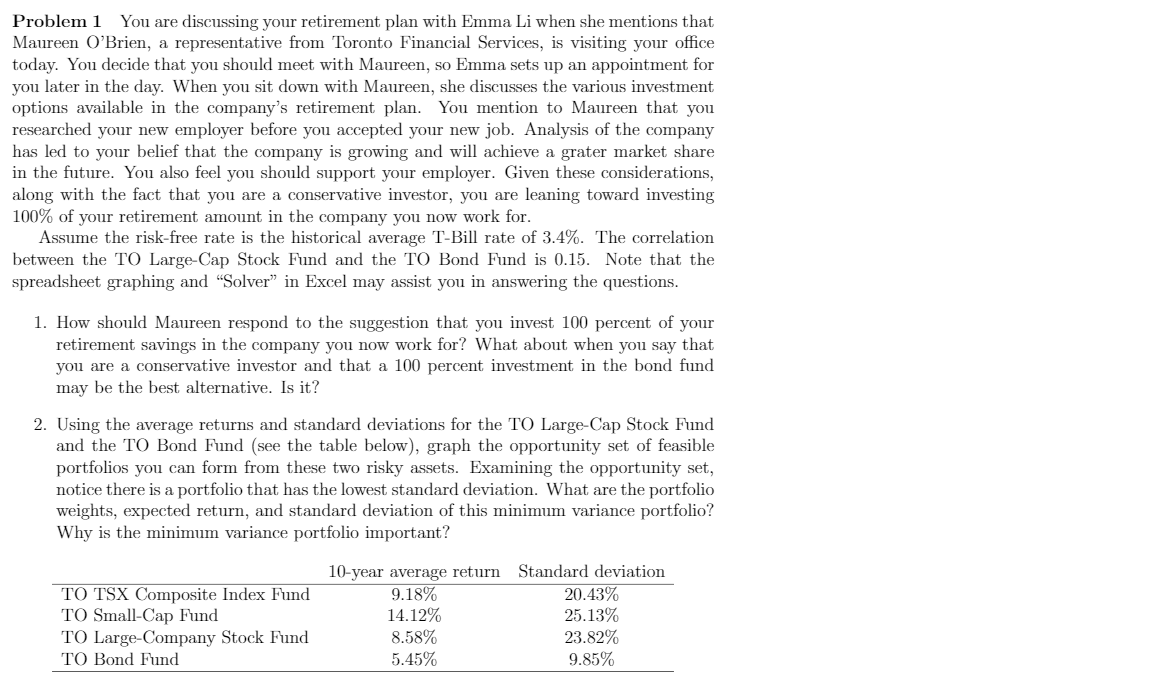
Problem 1 You are discussing your retirement plan with Emma Li when she mentions that Maureen O'Brien, a representative from Toronto Financial Services, is visiting your office today. You decide that you should meet with Maureen, so Emma sets up an appointment for you later in the day. When you sit down with Maureen, she discusses the various investment options available in the company's retirement plan. You mention to Maureen that you researched your new employer before you accepted your new job. Analysis of the company has led to your belief that the company is growing and will achieve a grater market share in the future. You also feel you should support your employer. Given these considerations, along with the fact that you are a conservative investor, you are leaning toward investing 100% of your retirement amount in the company you now work for. Assume the risk-free rate is the historical average T-Bill rate of 3.4%. The correlation between the TO Large-Cap Stock Fund and the TO Bond Fund is 0.15. Note that the spreadsheet graphing and "Solver in Excel may assist you in answering the questions. 1. How should Maureen respond to the suggestion that you invest 100 percent of your retirement savings in the company you now work for? What about when you say that you are a conservative investor and that a 100 percent investment in the bond fund may be the best alternative. Is it? 2. Using the average returns and standard deviations for the TO Large-Cap Stock Fund and the TO Bond Fund (see the table below), graph the opportunity set of feasible portfolios you can form from these two risky assets. Examining the opportunity set, notice there is a portfolio that has the lowest standard deviation. What are the portfolio weights, expected return, and standard deviation of this minimum variance portfolio? Why is the minimum variance portfolio important? TO TSX Composite Index Fund TO Small-Cap Fund TO Large-Company Stock Fund TO Bond Fund 10-year average return Standard deviation 9.18% 20.43% 14.12% 25.13% 8.58% 23.82% 5.45% 9.85% Problem 1 You are discussing your retirement plan with Emma Li when she mentions that Maureen O'Brien, a representative from Toronto Financial Services, is visiting your office today. You decide that you should meet with Maureen, so Emma sets up an appointment for you later in the day. When you sit down with Maureen, she discusses the various investment options available in the company's retirement plan. You mention to Maureen that you researched your new employer before you accepted your new job. Analysis of the company has led to your belief that the company is growing and will achieve a grater market share in the future. You also feel you should support your employer. Given these considerations, along with the fact that you are a conservative investor, you are leaning toward investing 100% of your retirement amount in the company you now work for. Assume the risk-free rate is the historical average T-Bill rate of 3.4%. The correlation between the TO Large-Cap Stock Fund and the TO Bond Fund is 0.15. Note that the spreadsheet graphing and "Solver in Excel may assist you in answering the questions. 1. How should Maureen respond to the suggestion that you invest 100 percent of your retirement savings in the company you now work for? What about when you say that you are a conservative investor and that a 100 percent investment in the bond fund may be the best alternative. Is it? 2. Using the average returns and standard deviations for the TO Large-Cap Stock Fund and the TO Bond Fund (see the table below), graph the opportunity set of feasible portfolios you can form from these two risky assets. Examining the opportunity set, notice there is a portfolio that has the lowest standard deviation. What are the portfolio weights, expected return, and standard deviation of this minimum variance portfolio? Why is the minimum variance portfolio important? TO TSX Composite Index Fund TO Small-Cap Fund TO Large-Company Stock Fund TO Bond Fund 10-year average return Standard deviation 9.18% 20.43% 14.12% 25.13% 8.58% 23.82% 5.45% 9.85%
Step by Step Solution
There are 3 Steps involved in it

Get step-by-step solutions from verified subject matter experts