







Question: Problem 10.9 Given the following imaging parameters, determine Tacq in each case. a) Find Tacq for a 2D spatial imaging experiment with Ny =
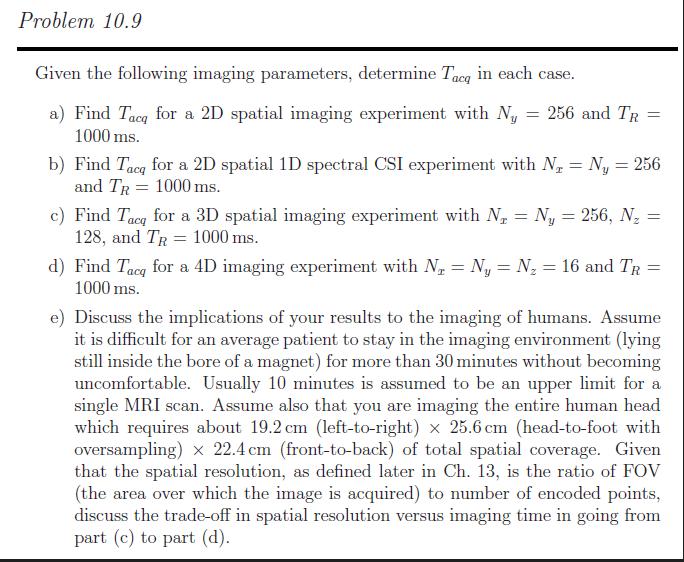
Problem 10.9 Given the following imaging parameters, determine Tacq in each case. a) Find Tacq for a 2D spatial imaging experiment with Ny = 256 and TR 1000 ms. = b) Find Tacq for a 2D spatial 1D spectral CSI experiment with N N = 256 and TR 1000 ms. = = c) Find Tacq for a 3D spatial imaging experiment with N = Ny = 256, N = 128, and TR = 1000 ms. d) Find Tacq for a 4D imaging experiment with Nr = Ny = N = 16 and TR = 1000 ms. e) Discuss the implications of your results to the imaging of humans. Assume it is difficult for an average patient to stay in the imaging environment (lying still inside the bore of a magnet) for more than 30 minutes without becoming uncomfortable. Usually 10 minutes is assumed to be an upper limit for a single MRI scan. Assume also that you are imaging the entire human head which requires about 19.2 cm (left-to-right) x 25.6 cm (head-to-foot with oversampling) x 22.4 cm (front-to-back) of total spatial coverage. Given that the spatial resolution, as defined later in Ch. 13, is the ratio of FOV (the area over which the image is acquired) to number of encoded points, discuss the trade-off in spatial resolution versus imaging time in going from part (c) to part (d).
Step by Step Solution
3.64 Rating (162 Votes )
There are 3 Steps involved in it
Given the following imaging parameters determine Tacq in each case Find Tacq for a 2D spatial imaging experiment with Ny 256 and TR 1000 ms Tacq Ny TR Tacq 256 1000 ms Tacq 256000 ms Find Tacq for a 3... View full answer

Get step-by-step solutions from verified subject matter experts
 Study Help