Question: Problem 11-10 Refer to Solved Problem 1 in the textbook. A manager is attempting to put together an aggregate plan for the coming nine months.
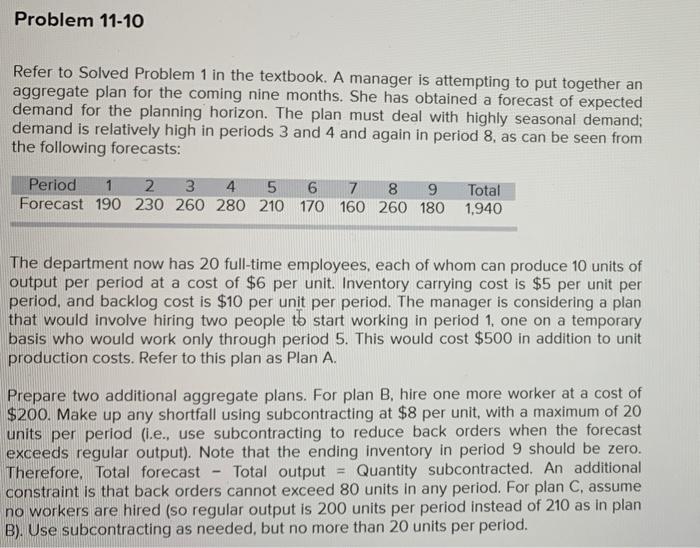
Problem 11-10 Refer to Solved Problem 1 in the textbook. A manager is attempting to put together an aggregate plan for the coming nine months. She has obtained a forecast of expected demand for the planning horizon. The plan must deal with highly seasonal demand: demand is relatively high in periods 3 and 4 and again in period 8, as can be seen from the following forecasts: Period 1 2 3 4 5 6 7 8 9 Total Forecast 190 230 260 280 210 170 160 260 180 1,940 The department now has 20 full-time employees, each of whom can produce 10 units of output per period at a cost of $6 per unit. Inventory carrying cost is $5 per unit per period, and backlog cost is $10 per unit per period. The manager is considering a plan that would involve hiring two people to start working in period 1. one on a temporary basis who would work only through period 5. This would cost $500 in addition to unit production costs. Refer to this plan as Plan A. Prepare two additional aggregate plans. For plan B, hire one more worker at a cost of $200. Make up any shortfall using subcontracting at $8 per unit, with a maximum of 20 units per period (.e., use subcontracting to reduce back orders when the forecast exceeds regular output). Note that the ending inventory in period 9 should be zero. Therefore, Total forecast Total output = Quantity subcontracted. An additional constraint is that back orders cannot exceed 80 units in any period. For plan C, assume no workers are hired (so regular output is 200 units per period instead of 210 as in plan B). Use subcontracting as needed, but no more than 20 units per period. basis who would work only through period 5. This would cost $500 in addition to unit production costs. Refer to this plan as Plan A. Prepare two additional aggregate plans. For plan B, hire one more worker at a cost of $200. Make up any shortfall using subcontracting at $8 per unit, with a maximum of 20 units per period (i.e., use subcontracting to reduce back orders when the forecast exceeds regular output). Note that the ending inventory in period 9 should be zero. Therefore, Total forecast Total output Quantity subcontracted. An additional constraint is that back orders cannot exceed 80 units in any period. For plan C, assume no workers are hired (so regular output is 200 units per period instead of 210 as in plan B). Use subcontracting as needed, but no more than 20 units per period. a. Compute the total cost of each plan. (Omit the "$" sign in your response.) Plan A B Total cost $ $ $ I b. Which plan has the lowest cost? OA OB Problem 11-10 Refer to Solved Problem 1 in the textbook. A manager is attempting to put together an aggregate plan for the coming nine months. She has obtained a forecast of expected demand for the planning horizon. The plan must deal with highly seasonal demand: demand is relatively high in periods 3 and 4 and again in period 8, as can be seen from the following forecasts: Period 1 2 3 4 5 6 7 8 9 Total Forecast 190 230 260 280 210 170 160 260 180 1,940 The department now has 20 full-time employees, each of whom can produce 10 units of output per period at a cost of $6 per unit. Inventory carrying cost is $5 per unit per period, and backlog cost is $10 per unit per period. The manager is considering a plan that would involve hiring two people to start working in period 1. one on a temporary basis who would work only through period 5. This would cost $500 in addition to unit production costs. Refer to this plan as Plan A. Prepare two additional aggregate plans. For plan B, hire one more worker at a cost of $200. Make up any shortfall using subcontracting at $8 per unit, with a maximum of 20 units per period (.e., use subcontracting to reduce back orders when the forecast exceeds regular output). Note that the ending inventory in period 9 should be zero. Therefore, Total forecast Total output = Quantity subcontracted. An additional constraint is that back orders cannot exceed 80 units in any period. For plan C, assume no workers are hired (so regular output is 200 units per period instead of 210 as in plan B). Use subcontracting as needed, but no more than 20 units per period. basis who would work only through period 5. This would cost $500 in addition to unit production costs. Refer to this plan as Plan A. Prepare two additional aggregate plans. For plan B, hire one more worker at a cost of $200. Make up any shortfall using subcontracting at $8 per unit, with a maximum of 20 units per period (i.e., use subcontracting to reduce back orders when the forecast exceeds regular output). Note that the ending inventory in period 9 should be zero. Therefore, Total forecast Total output Quantity subcontracted. An additional constraint is that back orders cannot exceed 80 units in any period. For plan C, assume no workers are hired (so regular output is 200 units per period instead of 210 as in plan B). Use subcontracting as needed, but no more than 20 units per period. a. Compute the total cost of each plan. (Omit the "$" sign in your response.) Plan A B Total cost $ $ $ I b. Which plan has the lowest cost? OA OB









 Study Help