



Question: Problem 11-17 (WACC Estimation) The following table gives the balance sheet for Travellers Inn Inc. (TII), a company that was formed by merging a number
Problem 11-17 (WACC Estimation)
The following table gives the balance sheet for Travellers Inn Inc. (TII), a company that was formed by merging a number of regional motel chain
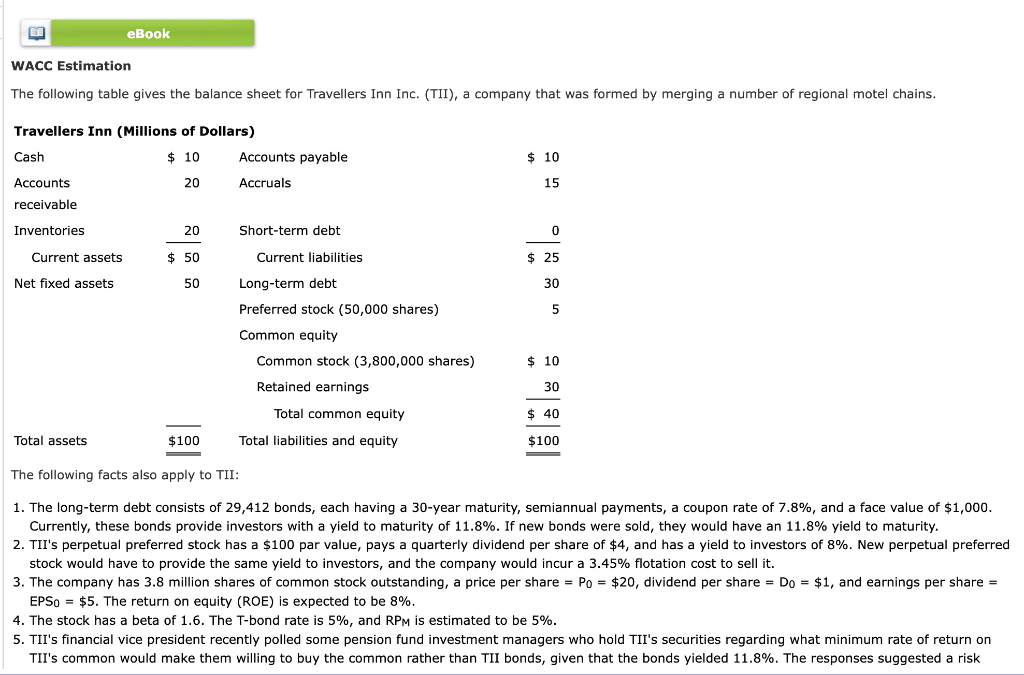
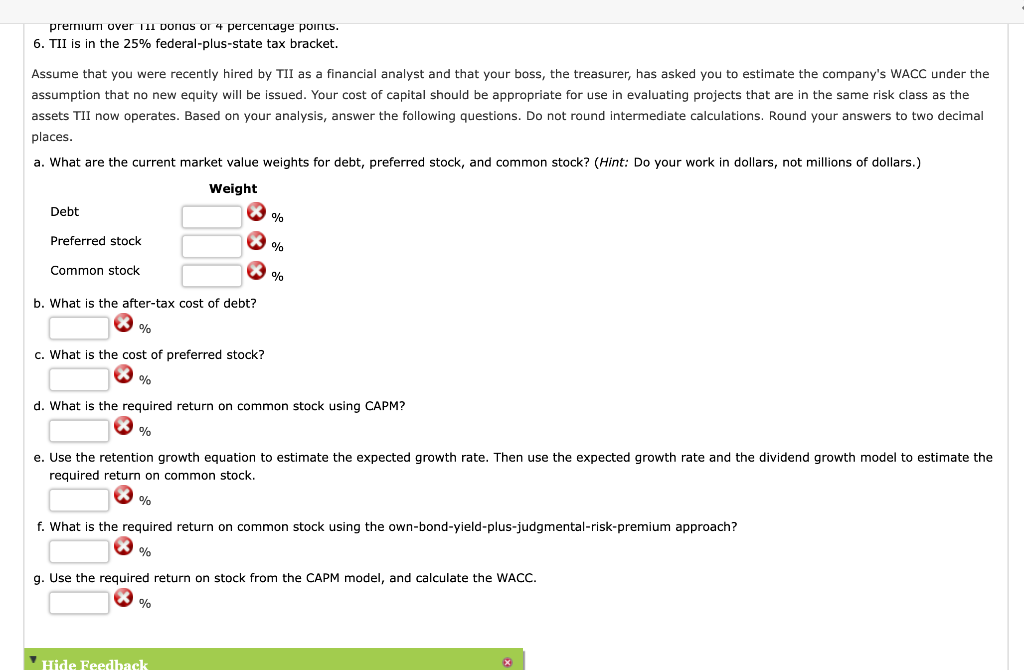
The following table gives the balance sheet for Travellers Inn Inc. (TII), a company that was formed by merging a number of reains. The following facts also apply to TII: 1. The long-term debt consists of 29,412 bonds, each having a 30 -year maturity, semiannual payments, a coupon rate of 7.8%, and a face value Currently, these bonds provide investors with a yield to maturity of 11.8%. If new bonds were sold, they would have an 11.8% yield to maturity. 2. TII's perpetual preferred stock has a $100 par value, pays a quarterly dividend per share of $4, and has a yield to investors of 8%. New perpetual stock would have to provide the same yield to investors, and the company would incur a 3.45% flotation cost to sell it. 3. The company has 3.8 million shares of common stock outstanding, a price per share =P0=$20, dividend per share =D0=$1, and earnings per share EPS 0=$5. The return on equity (ROE) is expected to be 8%. 4. The stock has a beta of 1.6. The T-bond rate is 5%, and RPM is estimated to be 5%. TII's common would make them willing to buy the common rather than TII bonds, given that the bonds yielded 11.8%. The responses suggested a risk preminm over 111 donas or 4 percentage points. 6 . TII is in the 25% federal-plus-state tax bracket. Assume that you were recently hired by TII as a financial analyst and that your boss, the treasurer, has asked you to estimate the company's WACC under the places. a. What are the current market value weights for debt, preferred stock, and common stock? (Hint: Do your work in dollars, not millions of dollars.) b. What is the after-tax cost of debt? c. What is the cost of preferred stock? % d. What is the required return on common stock using CAPM? 3% e. Use the retention growth equation to estimate the expected growth rate. Then use the expected growth rate and the dividend growth model to estimate the required return on common stock. 3% f. What is the required return on common stock using the own-bond-yield-plus-judgmental-risk-premium approach? 3% g. Use the required return on stock from the CAPM model, and calculate the WACC. 3% The following table gives the balance sheet for Travellers Inn Inc. (TII), a company that was formed by merging a number of reains. The following facts also apply to TII: 1. The long-term debt consists of 29,412 bonds, each having a 30 -year maturity, semiannual payments, a coupon rate of 7.8%, and a face value Currently, these bonds provide investors with a yield to maturity of 11.8%. If new bonds were sold, they would have an 11.8% yield to maturity. 2. TII's perpetual preferred stock has a $100 par value, pays a quarterly dividend per share of $4, and has a yield to investors of 8%. New perpetual stock would have to provide the same yield to investors, and the company would incur a 3.45% flotation cost to sell it. 3. The company has 3.8 million shares of common stock outstanding, a price per share =P0=$20, dividend per share =D0=$1, and earnings per share EPS 0=$5. The return on equity (ROE) is expected to be 8%. 4. The stock has a beta of 1.6. The T-bond rate is 5%, and RPM is estimated to be 5%. TII's common would make them willing to buy the common rather than TII bonds, given that the bonds yielded 11.8%. The responses suggested a risk preminm over 111 donas or 4 percentage points. 6 . TII is in the 25% federal-plus-state tax bracket. Assume that you were recently hired by TII as a financial analyst and that your boss, the treasurer, has asked you to estimate the company's WACC under the places. a. What are the current market value weights for debt, preferred stock, and common stock? (Hint: Do your work in dollars, not millions of dollars.) b. What is the after-tax cost of debt? c. What is the cost of preferred stock? % d. What is the required return on common stock using CAPM? 3% e. Use the retention growth equation to estimate the expected growth rate. Then use the expected growth rate and the dividend growth model to estimate the required return on common stock. 3% f. What is the required return on common stock using the own-bond-yield-plus-judgmental-risk-premium approach? 3% g. Use the required return on stock from the CAPM model, and calculate the WACC. 3%
Step by Step Solution
There are 3 Steps involved in it

Get step-by-step solutions from verified subject matter experts