



Question: Problem 13-02 a. A $1,000 bond has a 6.5 percent coupon and matures after eleven years. If current interest rates are 9 percent, what should
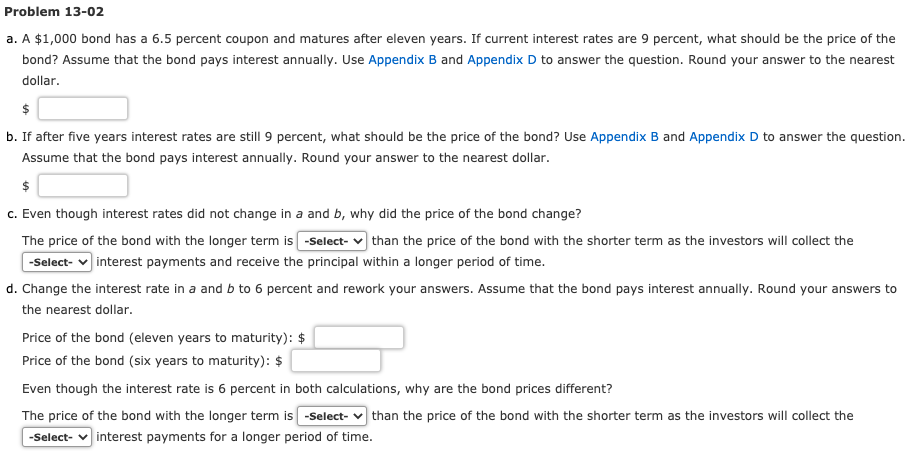
Problem 13-02 a. A $1,000 bond has a 6.5 percent coupon and matures after eleven years. If current interest rates are 9 percent, what should be the price of the bond? Assume that the bond pays interest annually. Use Appendix B and Appendix D to answer the question. Round your answer to the nearest dollar. $ b. If after five years interest rates are still 9 percent, what should be the price of the bond? Use Appendix B and Appendix D to answer the question. Assume that the bond pays interest annually. Round your answer to the nearest dollar. $ c. Even though interest rates did not change in a and b, why did the price of the bond change? The price of the bond with the longer term is -Select than the price of the bond with the shorter term as the investors will collect the -Select-vinterest payments and receive the principal within a longer period of time. d. Change the interest rate in a and b to 6 percent and rework your answers. Assume that the bond pays interest annually. Round your answers to the nearest dollar. Price of the bond (eleven years to maturity): $ Price of the bond (six years to maturity): $ Even though the interest rate is 6 percent in both calculations, why are the bond prices different? The price of the bond with the longer term is -Select-than the price of the bond with the shorter term as the investors will collect the -Select- interest payments for a longer period of time. Problem 13-02 a. A $1,000 bond has a 6.5 percent coupon and matures after eleven years. If current interest rates are 9 percent, what should be the price of the bond? Assume that the bond pays interest annually. Use Appendix B and Appendix D to answer the question. Round your answer to the nearest dollar. $ b. If after five years interest rates are still 9 percent, what should be the price of the bond? Use Appendix B and Appendix D to answer the question. Assume that the bond pays interest annually. Round your answer to the nearest dollar. $ c. Even though interest rates did not change in a and b, why did the price of the bond change? The price of the bond with the longer term is -Select than the price of the bond with the shorter term as the investors will collect the -Select-vinterest payments and receive the principal within a longer period of time. d. Change the interest rate in a and b to 6 percent and rework your answers. Assume that the bond pays interest annually. Round your answers to the nearest dollar. Price of the bond (eleven years to maturity): $ Price of the bond (six years to maturity): $ Even though the interest rate is 6 percent in both calculations, why are the bond prices different? The price of the bond with the longer term is -Select-than the price of the bond with the shorter term as the investors will collect the -Select- interest payments for a longer period of time
Step by Step Solution
There are 3 Steps involved in it

Get step-by-step solutions from verified subject matter experts