







Question: Problem 13.1.1 Show the payoff matrix and explain the reasoning in the prisoners' dilemma example where Larry and Duncan, possible criminals, will get one year
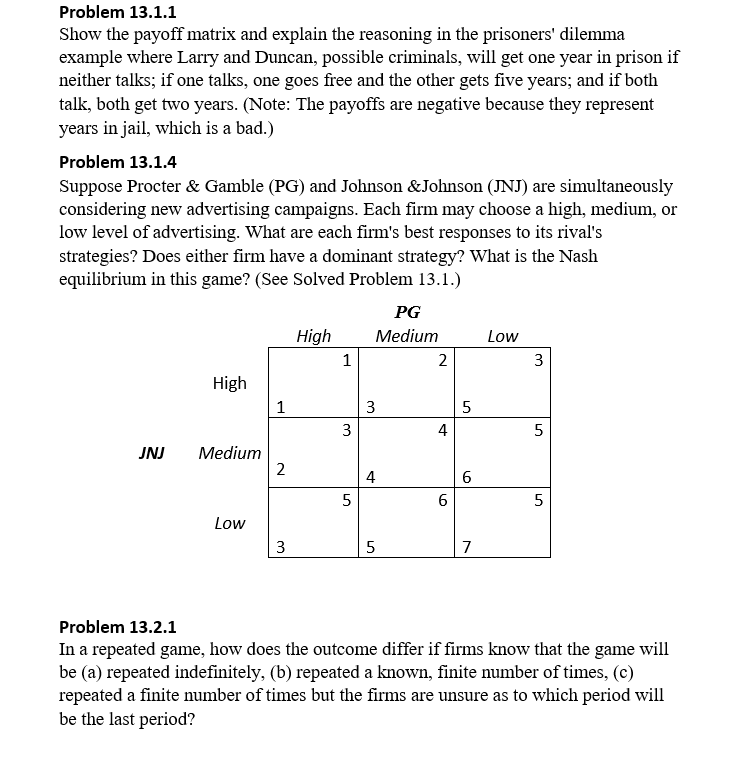
Problem 13.1.1 Show the payoff matrix and explain the reasoning in the prisoners' dilemma example where Larry and Duncan, possible criminals, will get one year in prison if neither talks; if one talks, one goes free and the other gets five years; and if both talk, both get two years. (Note: The payoffs are negative because they represent years in jail, which is a bad.) Problem 13.1.4 Suppose Procter & Gamble (PG) and Johnson & Johnson (JNJ) are simultaneously considering new advertising campaigns. Each firm may choose a high, medium, or low level of advertising. What are each firm's best responses to its rival's strategies? Does either firm have a dominant strategy? What is the Nash equilibrium in this game? (See Solved Problem 13.1.) PG High Medium Low 1 3 High 3 5 4 5 INJ Medium 2 4 6 5 6 5 Low 3 5 7 Problem 13.2.1 In a repeated game, how does the outcome differ if firms know that the game will be (a) repeated indefinitely, (b) repeated a known, finite number of times, (c) repeated a finite number of times but the firms are unsure as to which period will be the last period
Step by Step Solution
There are 3 Steps involved in it

Get step-by-step solutions from verified subject matter experts
 Study Help