







Question: Consider the system of two blocks and a spring shown in (Figure 1). The horizontal surface is frictionless, but there is static friction between
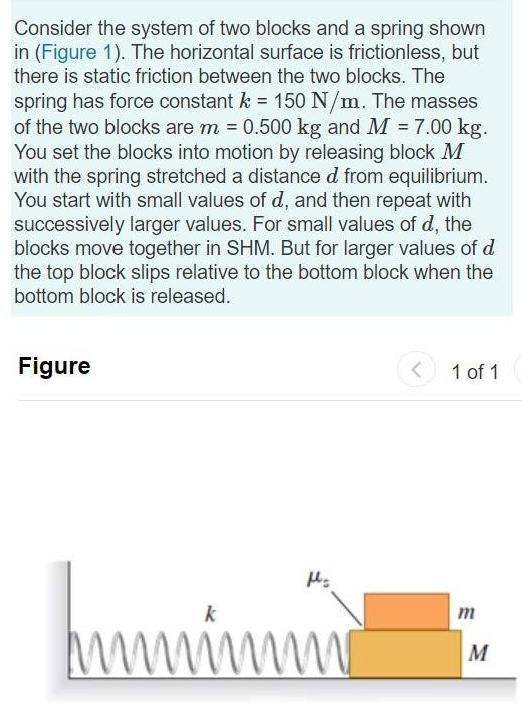
Consider the system of two blocks and a spring shown in (Figure 1). The horizontal surface is frictionless, but there is static friction between the two blocks. The spring has force constant k = 150 N/m. The masses of the two blocks are m = 0.500 kg and M = 7.00 kg. You set the blocks into motion by releasing block M with the spring stretched a distance d from equilibrium. You start with small values of d, and then repeat with successively larger values. For small values of d, the blocks move together in SHM. But for larger values of d the top block slips relative to the bottom block when the bottom block is released. Figure 1 of 1 k m M Part A What is the period of the motion of the two blocks when d is small enough to have no slipping? Express your answer with the appropriate units. H T = Value Units Part B The largest value d can have and there be no slipping is 8.8 cm. What is the coefficient of static friction us between the surfaces of the two blocks? Express your answer to two significant figures. Us =
Step by Step Solution
3.44 Rating (163 Votes )
There are 3 Steps involved in it

Get step-by-step solutions from verified subject matter experts
 Study Help