







Question: Problem 16-01 (Algorithmic) Suppose we are interested in analyzing the market share and customer loyalty for Murphy's Foodliner and Ashley's Supermarket, the only two grocery
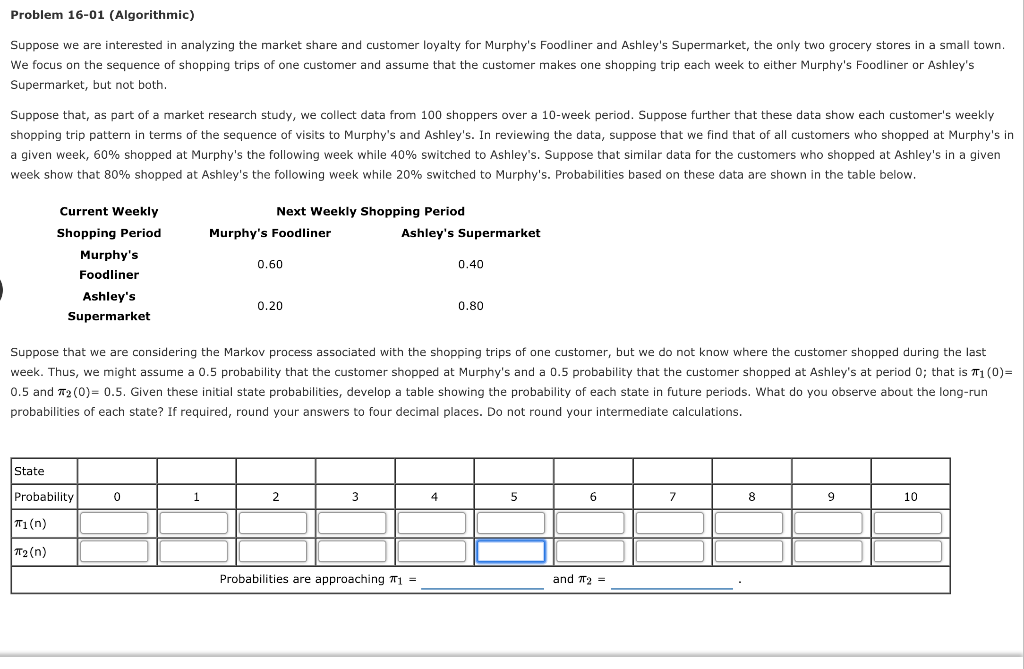
Problem 16-01 (Algorithmic) Suppose we are interested in analyzing the market share and customer loyalty for Murphy's Foodliner and Ashley's Supermarket, the only two grocery stores in a small town We focus on the sequence of shopping trips of one customer and assume that the customer makes one shopping trip each week to either Murphy's Foodliner or Ashley's Supermarket, but not both Suppose that, as part of a market research study, we collect data from 100 shoppers over a 10-week period. Suppose further that these data show each customer's weekly shopping trip pattern in terms of the sequence of visits to Murphy's and Ashley's. In reviewing the data, suppose that we find that of all customers who shopped at Murphy's in a given week, 60% shopped at Murphy's the following week while 40% switched to Ashley's. Suppose that similar data for the customers who shopped at Ashley's in a given week show that 80% shopped at Ashley's the following week while 20% switched to Murphy's. Probabilities based on these data are shown in the table below Current Weekly Shopping Period Murphy's Foodliner Ashley's Supermarket Next Weekly Shopping Period Murphy's Foodliner Ashley's Supermarket 0.60 0.40 0.20 0.80 Suppose that we are considering the Markov process associated with the shopping trips of one customer, but we do not know where the customer shopped during the last week. Thus, we might assume a 0.5 probability that the customer shopped at Murphy's and a 0.5 probability that the customer shopped at Ashley's at period 0; that is 1(0)- 0.5 and 2(0)= 0.5. Given these initial state probabilities, develop a table showing the probability of each state in future periods, what do you observe about the long-run probabilities of each state? If required, round your answers to four decimal places. Do not round your intermediate calculations State Probability T1(n) T2 (n) 4 9 10 Probabilities are approaching T1- and T2
Step by Step Solution
There are 3 Steps involved in it

Get step-by-step solutions from verified subject matter experts
 Study Help