





Question: Problem 16-07 (Algorithmic) Data collected from selected major metropolitan areas in the eastern United States show that 4% of individuals living within the city limits
Problem 16-07 (Algorithmic) Data collected from

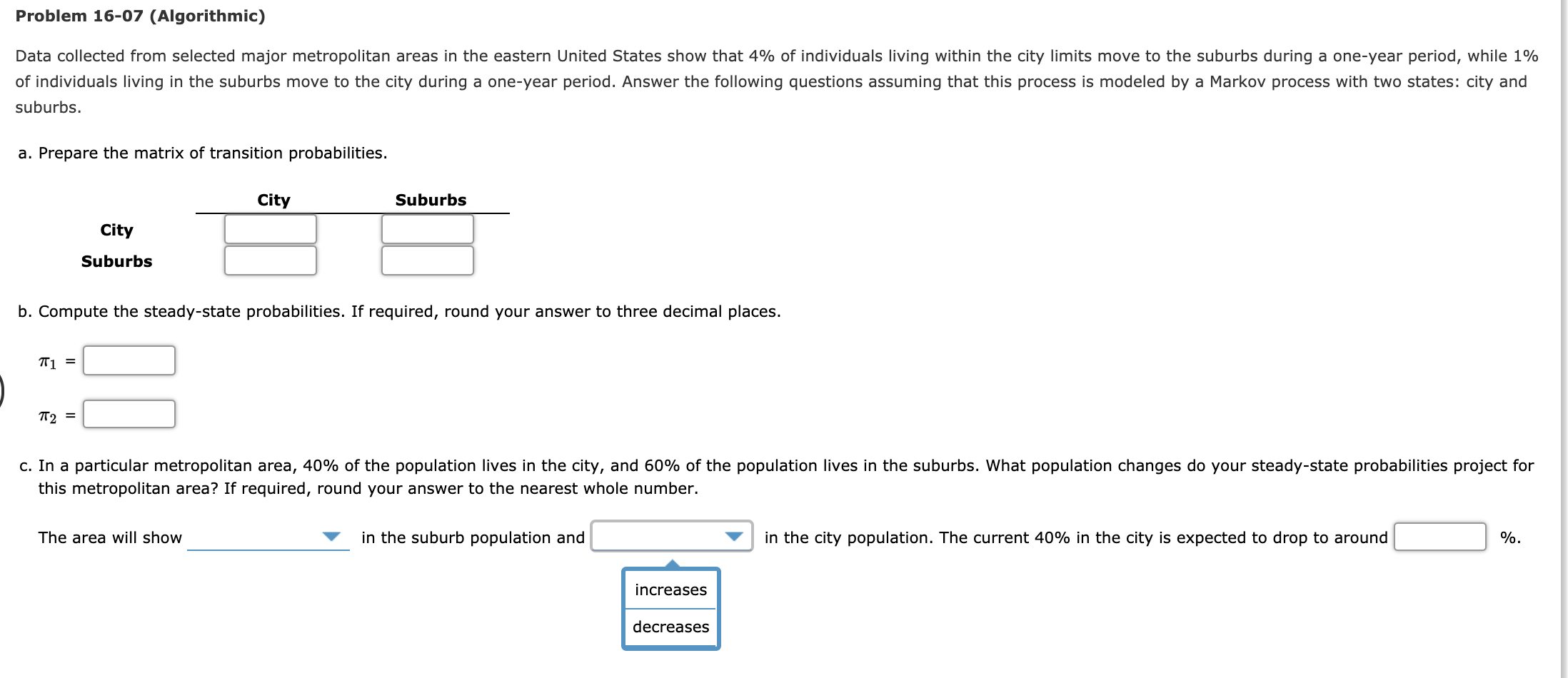
Problem 16-07 (Algorithmic) Data collected from selected major metropolitan areas in the eastern United States show that 4% of individuals living within the city limits move to the suburbs during a one-year period, while 1% of individuals living in the suburbs move to the city during a one-year period. Answer the following questions assuming that this process is modeled by a Markov process with two states: city and suburbs. a. Prepare the matrix of transition probabilities. City Suburbs City Suburbs b. Compute the steady-state probabilities. If required, round your answer to three decimal places. Ti = T2 = c. In a particular metropolitan area, 40% of the population lives in the city, and 60% of the population lives in the suburbs. What population changes do your steady-state probabilities project for this metropolitan area? If required, round your answer to the nearest whole number. The area will show in the suburb population and in the city population. The current 40% in the city is expected to drop to around %. increases decreases

Step by Step Solution

There are 3 Steps involved in it

1 Expert Approved Answer
Step: 1 Unlock blur-text-image

Question Has Been Solved by an Expert!

Get step-by-step solutions from verified subject matter experts

Step: 2 Unlock
Step: 3 Unlock

Students Have Also Explored These Related General Management Questions!